ALAN 3 BEGINNER'S GUIDE
ALAN 3 BEGINNER'S GUIDE

The Alan Adventure Language
created by Thomas Nilsson
Beginner's Guide
by Michael Arnaud © 2006
Introduction to Alan 3
-
Introduction to Alan 3 ALAN 3 BEGINNER'S GUIDEby Michael Arnaud © 2006Introduction to ALAN version 3From the ALAN website (http://www.alanif.se/):"Alan is one of the most easy to use tools specialized for creating works of Interactive Fiction, a.k.a text adventures. It's focus has always been on the authoring aspects."According to the rec-arts interactive fiction FAQ, ALAN version 2 is included in the "Tier I" of Interactive Fiction programming languages, along with Inform, TADS, and Hugo. That is very good company.Recently, TADS has been updated with TADS 3 -- not just a revision, but an essentially new language, which may well be the most powerful "Adventure Development System" out there. There are rumors at the time of this writing of a similar update -- more than mere revision -- of Inform as well, with promises of greater power and versatility in this already excellent and popular language.Interestingly, ALAN has undergone the revision process as well (I don't know if Thomas Nilsson saw the other languages revising and decided, "Me too!", though I tend to think not. On the ALAN website he describes this revision process as beginning "a couple of years ago...").Like TADS 3 (and if the rumors are true "Inform 7"), ALAN 3 is not just a revision or update of ALAN version 2. ALAN 3 incorporates "object oriented programming" (OOP) and is much more powerful, more versatile and capable than ALAN 2. It will surprise those who are unfamiliar with ALAN how very powerful it is; and those who are familiar only with ALAN 2 ought to be very pleased with the new ALAN 3 language.Every programming language has its distinct advantages. TADS 3, for example, has a completely programmable parser. Inform is ported for just about any machine out there, including handhelds. Hugo can implement nearly every kind of multimedia an author might wish to put into his or her game.ALAN 3's most notable distinction from the other adventure languages is its ease of use and lower learning-curve. Even though it is a powerful Tier I language, ALAN 3 is considerably easier for an inexperienced or "non-programming" author to use than the other languages. It is a "higher" language; that is, it is much more like English than "computerese". ALAN 3 does not use confusing brackets and braces, semicolons, or other C, C++, Pascal and other such programming conventions as used in TADS, Inform, and Hugo.Introduction to this Guide
-
Introduction to this Guide Introduction to This Beginner's GuideThis material is not a manual. This is only a primer, a beginner's guide. The focus of this guide is on writing a game with the ALAN 3 adventure language. Technical questions and those concerning software issues such as compiler switches or debugging are best addressed by the manual. This guide does not cover everything that ALAN 3 is capable of, nor is its claim to exhaustively cover anything ALAN 3 is capable of. Therefore I highly recommend familiarity with the ALAN 3 manual as your main source of information.Paragraph symbols ( ¶ ) throughout this guide refer to paragraph numbers in the Alan Manual.Another thing I recommend is browsing the archived messages at the ALAN Yahoo! Group. You can learn about the development of ALAN 3 as it has progressed, hitting snags and bugs that were fixed along the way. You can find programming help for more advanced and tricky techniques in ALAN 3 that we will not go into in this beginner's guide.If you are new to writing Interactive Fiction games or new to programming, I recommend that you read this guide through from beginning to end to get a full overview of what it covers. Then go through it again more slowly, working through the steps one at a time to master them.As has been done in primers for other IF languages such as Inform and TADS, we will build a complete though simple game one step at a time and then develop it into one somewhat more complex. Before we get to that, however, there are a few things you will need besides this beginner's guide. Tools You Will Need
-
Tools You Will Need Tools You Will Need (¶ 2.3.1)You need the ALAN 3 programming system (available for Windows, Mac, or Linux), which includes the ALAN manual in PDF format, the compiler, and the interpreter. (I also recommend the third-party Gargoyle interpreter, which has a very pleasant display for ALAN and other game files.)You will also need the standard library. The library is a set of preprogrammed basic verbs and classes. The standard library is not included with the ALAN programming system and must be downloaded separately. You can download both the programming system and the standard library from the ALAN website.Text EditorIt is also very highly desirable to use a text editor rather than a word processor to write your source code. First and foremost, source code must be in plain text format, without the special formatting that word processors use. Second, it is helpful to have quick and easy access to multiple files (such as the standard library files) that most text editors provide. Most text editors will also provide means within the program itself to compile the source code into a game file.There are several good text editors available free online. The ALAN 3 website and manual suggest Imaginate, which has syntax highlighting that some people find helpful.* I prefer Crimson Editor, available as freeware.(*At the time of this writing, Imaginate supports version 2 but not yet version 3.)Image EditorALAN 3 supports jpeg images (and some audio formats). Our tutorial game will include such an image. You might wish to convert, resize, or otherwise manipulate images to include in your game. An excellent freeware program, Irfanview, is available that can help you do these things.NOTE: If you plan to release your game to the public, be sure the images used are free of copyright. Comments in the Code
-
Comments in the Code COMMENTS IN THE CODEThe First Few LinesOkay, let's get started. Start a new file in the text editor and save it as "tvtime.alan". (Actually, you can name it "mygame.alan" or whatever you want, but the compiler will be looking for that .alan extension.)The first couple of lines of your source file should probably be something to identify what it is. In this beginner's guide we will do it this way (note than whenever new code is displayed in this guide it will be in RED):------------------------------------------------- *** TV TIME! ***-- An ALAN 3 Interactive Fiction Tutorial Game-- By Michael Arnaud © 2006-----------------------------------------------These lines won't do anything to, for, or in the game. They are just there for anyone who happens to read the source file. These are called "comment" statements (in some computer languages they are called "REMARK" statements), and are written in ALAN 3 with a double-hyphen (--) at the beginning of every comment.Whenever the compiler sees a double-hyphen, it ignores everything that follows on that line. We can make notes, reminders, and explain things throughout our program this way.Now we are ready to program our beginning LOCATION -- what other IF languages usually refer to as a "Room".
PART ONE: LOCATIONS and EXITS
-
PART ONE: LOCATIONS and EXITS LOCATIONS and START AT
-
LOCATIONS and START AT LOCATIONS and the START AT StatementLOCATIONS are just "where" the player is located in the game map. Even though we usually think of LOCATIONS in terms of (as other IF languages might call them) "Rooms", they can be outdoors or indoors, under water, in outer space, or anywhere at all.The basic template for LOCATIONS is:-----------------------THE ? Isa LOCATIONNAME '?'DESCRIPTION"? ? ?"EXIT ? TO ?.END THE ?.-----------------------Following the format of the ALAN manual, we are using "?" as a stand-in or place-holder.The word "THE" is used to introduce specific instances (¶ 2.4.5) of LOCATIONS, OBJECTS, ACTORS, etc. In other words, with "THE", we are creating a particular LOCATION or a particular OBJECT, etc.The word "Isa" is an ALAN 3 programming word to identify what class THE (instance) IS. In this case, THE (instance) Isa (particular member of the class) LOCATION.The beginning LOCATION for our tutorial game is the TV Room. A completed LOCATION appropriately ends with an END statement, which itself ends with a full-stop (or period ".").THE tv_room Isa LOCATIONEND THE tv_room.The word "tv_room" is our programming word (using an underscore in the place of a space makes it a single word) for the first LOCATION . We could have called it "in_a_house", "spaceship", "gertrude", or anything at all.START AT the EndEvery game must tell the compiler where to start, using the START AT statement. The START AT statement always comes at the very end of your program.This is a complete game that will compile and run, though very limited in description or action. Try it.THE tv_room Isa LOCATIONEND THE tv_room.START AT tv_room.Adding a NAME and DESCRIPTIONIf we were to play the game at this point, we would not see anything about the TV Room, except "Tv_room" (note that the interpreter capitalized the first letter! ¶ 2.4.8). Following the template at the top of the page, we can add a NAME and DESCRIPTION. Type in the NAME statement followed by what you want the game to display as the NAME of the LOCATION. Be sure to enclose it in single (not double) quotes.THE tv_room Isa LOCATIONNAME 'TV Room'...(We sometimes use the ellipse ... in this guide to indicate that there is more code preceding and/or following.)Now fill out a brief DESCRIPTION of the LOCATION, basically telling the player what he/she sees when entering. DESCRIPTIONS, as information displayed to the player, are placed within double quotes.THE tv_room Isa LOCATIONNAME 'TV Room'DESCRIPTION"This is your favorite room in the house, because you love to watch television. You recently purchased a giant screen plasma TV that is set up in this room, ideally located across from your comfy chair and table."END THE tv_room....Compile and run the game to see how this is displayed to the player.Another LOCATIONUsing the same basic template, let's make a second simple LOCATION:THE kitchen Isa LOCATIONNAME 'Kitchen'DESCRIPTION"This is the kitchen."END THE kitchen. EXITS
-
EXITS EXITSWe need an EXIT strategyIn game play, the player starts in the TV Room and is locked in. He/She cannot see or go into the Kitchen. They need some way to move from the TV Room to the Kitchen. This is most often accomplished with an EXIT.Note that EXITS are always one-way. If we want the EXIT to work in both directions (for example, "south" to the Kitchen, and "north" back to the TV Room), we need to put an EXIT in the other LOCATION....THE tv_room Isa LOCATIONNAME 'TV Room'DESCRIPTION"This is your favorite room in the house, because you love to watch television. You recently purchased a giant screen plasma TV that is set up in this room, ideally located across from your comfy chair and table. "EXIT south TO kitchen. -- Note the full-stop.END THE tv_room.-----------------------THE kitchen Isa LOCATIONNAME 'Kitchen'DESCRIPTION"This is the kitchen."EXIT north TO tv_room.END THE kitchen.-----------------------START AT tv_room.Compile and run the game. You can go back and forth from the TV Room to the Kitchen.DIRECTIONS TO Nowhere
-
DIRECTIONS TO Nowhere DIRECTIONS to NowhereIn our game so far, we have programmed EXITS "south" from the TV Room and "north" from the Kitchen. But suppose the player would like to go east or west or up or down? The interpreter does not know what any of those words mean, and will tell the player so.> westI don't know the word 'west'.The remedy is to include in our program every different direction we might use in our game. We need not use any of the standard directional words at all. We can use "thisaway", "thataway", "moonward", or anything we want. However, most players of Interactive Fiction are used to playing with at least the four cardinal directions, plus "up" and "down". They will need some instruction within the game if we want them to try such directions as "moonward".This Is Going NOWHEREOne of the most convenient devices we can use in the Alan adventure language is what the manual calls a "limbo" LOCATION (¶ 2.4.6). That is, a LOCATION that the player never sees or knows anything about, he cannot travel there or back again. We can use such a limbo LOCATION to establish any directional or EXIT words we want. We could call our limbo LOCATION "limbo", "bimbo", or anything else, but for our game we will call it "Nowhere". Put these lines before the code for the tv_room:....THE Nowhere Isa LOCATIONEXIT north TO Nowhere.EXIT south TO nowhere.EXIT west TO nowhere.EXIT east TO nowhere.EXIT up TO nowhere.EXIT down TO nowhere.END THE nowhere.THE tv_room Isa LOCATIONNAME 'TV Room'...Now compile and play the game. Try to go "west" in the TV Room, and instead of getting the message "I don't know the word 'west'" you get the somewhat more reasonable response:>westYou can't go that way.N, S, W, EIt is an IF convention that the player need only type "n" for north, "s" for south, and so on. But at this point if we type n, s, w, or e, we are back to "I don't know the word 'n'". We could program these single-letter words as we did the full words above:THE Nowhere Isa LOCATIONEXIT north TO Nowhere.EXIT south TO nowhere.EXIT west TO nowhere.EXIT east TO nowhere.EXIT up TO nowhere.EXIT down TO nowhere.EXIT n TO Nowhere.EXIT s TO Nowhere.EXIT w TO Nowhere.EXIT e TO Nowhere.END THE nowhere.The problem with this is, both "north" and "n" are two separate directions. We would have to program the Kitchen, for example, with both of them to go to the same place:THE kitchen Isa LOCATIONNAME 'Kitchen'DESCRIPTION"This is the kitchen."EXIT north TO tv_room.EXIT n TO tv_room.END THE kitchen.If we had four or more directions to program from the Kitchen, we would also have to double that number just to have the abbreviations for each one. There is, however, a much easier way: use the SYNONYMS statement. SYNONYMS
-
SYNONYMS SYNONYMS Mean the Same ThingIt is a very simple matter to create synonyms, words (or letters) that the player can type and that will be understood by the interpreter to mean the same thing as the main original word.To create a synonym, simply use the SYNONYMS statement, then first the synonym word; then an equals sign followed by the word you want the synonym to equal. Be sure to end each synonym with a full-stop.SYNONYMSn = north.s = south.e = east.w = west.u = up.d = down.THE Nowhere Isa LOCATIONEXIT north TO Nowhere.EXIT south TO nowhere.EXIT west TO nowhere.EXIT east TO nowhere.EXIT up TO nowhere.EXIT down TO nowhere.END THE nowhere.THE tv_room Isa LOCATIONNAME 'TV Room'...Now the player can indicate which direction he/she would like to go with a single letter, rather than typing the full word. Try it. Nowhere in the Library
-
Nowhere in the Library Nowhere in the LibraryNow we are going to look at a big time-and-trouble saver, the standard library (see the Introduction). If you have downloaded the library you will find a folder called (as of this writing) "alanlib_6_1dev". The exact name of the folder may vary as later developments of ALAN and/or the library are released, but it will probably always begin at least with "alanlib".I highly recommend keeping the alanlib folder in a separate place on your computer from the ALAN V3 folder. Copy the alanlib folder into the ALAN V3 folder and rename it something like "my_lib" or "tv_lib" or whatever you like.Inside the folder is the standard library: a collection of files, most of which carry the extension, ".i". The letter "i" here stands for "import"; these are files that you are going to import into your main game file (which will be explained in a moment). For now, let's look at one of these ".i" files in particular, which you should be able to open with your text editor.The file to open is called "nowhere.i". It should look very familiar to you:-- nowhere.i-- Library version 0.5.0-- 0.4.1 - converted to ALANv3SYNONYMSn = north.s = south.e = east.w = west.ne = northeast.se = southeast.nw = northwest.sw = southwest.u = up.d = down.-- Useful for placing disappearing things-- Also defines the default directionsTHE nowhere ISA LOCATION.EXIT north TO nowhere.EXIT south TO nowhere.EXIT west TO nowhere.EXIT east TO nowhere.EXIT northeast TO nowhere.EXIT southeast TO nowhere.EXIT northwest TO nowhere.EXIT southwest TO nowhere.EXIT up TO nowhere.EXIT down TO nowhere.END THE nowhere.This is the same section of code we needed to establish various directions in our game, already written for us. The library has quite a few files of this sort, which you can explore with your text editor. Many of the library files may seem strange to you, but the system is really very simple and you will soon understand and use it all, quickly and easily. IMPORTING the Library
-
IMPORTING the Library Importing Is ImportantHow do we get all those library files into our game? Well, one way would be to open each one with the text editor and copy-and-paste it into our main game file. However, that would be tedious, it would add a lot of code for us to wade through in our source file, and it would be entirely unnecessary.All we need to do is put the following line in our source code (I recommend putting it right after the introductory comment statements):------------------------------------------------- *** TV TIME! ***-- An ALAN 3 Interactive Fiction Tutorial Game-- By Michael Arnaud © 2006-----------------------------------------------IMPORT 'std.i'.THE tv_room Isa LOCATION...Be sure to type it just this way, with the single-quotes around the name of the file and a full-stop at the end.How does that get "nowhere.i" into our game? Let's take a look. Open another file in the library, this one called "std.i" -- the one we are importing into our source file.-- std.i-- Library version 0.6.1-- All verb definitions have a small, simple default body. To make-- them do other things use DOES ONLY in your specialized verb body.-- player character, etcimport 'hero.i'.import 'global.i'.-- People, male/female etc.import 'people.i'.-- Standard verbsimport 'look.i'.import 'take.i'. -- + pick up, drop, put down.import 'open.i'. -- + close.import 'lock.i'. -- + unlock.import 'eat.i'. -- + drink.import 'throw.i'.import 'push.i'.import 'touch.i'.import 'examine.i'. -- + look at, searchimport 'read.i'.import 'put.i'. -- + put near,behind,on,underimport 'give.i'.import 'talk.i'. -- + ask, tell, say, shout,import 'attack.i'. -- + shootimport 'kiss.i'.import 'turn.i'. -- + switchimport 'listen.i'.import 'smell.i'.import 'knock.i'.import 'jump.i'.import 'wear.i'. -- + remove, undress, put onimport 'help.i'. -- + notes, hint-- Sceneryimport 'scenery.i'.-- Inventory verb and inventory limits (including clothing items)import 'invent.i'.-- The limbo location and directions-- Defines directions as full words, and short directions as synonyms to these.-- So remember to use the full words in your exits or you will have E 333's-- (e.g. 'e' defined both as a synonym and another word class)import 'nowhere.i'.-- Verbose and brief modeimport 'brief.i'.-- Score, save, restore etc.import 'meta.i'.Here's HowIn the std.i file there is a lengthy string of "import" statements. So here is how "nowhere.i" and a large collection of other pre-programmed files from the library are included in our program. When we typed that single lineIMPORT 'std.i'.we also imported all those other .i files in the library that are imported by the std.i file. This will save us a lot of time and trouble as we write our game.The remainder of this beginner's guide will assume that you have imported std.i and all its library files.Compile and play the game with the imported library. In the play of the game, type "help".> helpYou will see some helpful information displayed. This demonstrates the power of importing the library files. CHECKING EXITS
-
CHECKING EXITS CHECKING EXITSLet's return to our source file and the TV Room and Kitchen. We have imported the library files, so now while playing the game and in the TV Room we type ">w" or ">west", the interpreter will not tell us "I don't know the word 'west'", but will tell us> westYou can't go that way!It is generally desirable to tell the player why he/she "can't go that way", perhaps because there is a wall in that direction. Here's how we would do that:...THE tv_room Isa LOCATIONNAME 'TV Room'DESCRIPTION"This is your favorite room in the house, because you love to watch television. You recently purchased a giant screen plasma TV that is set up in this room, ideally located across from your comfy chair and table."EXIT south TO kitchen.EXIT north, east, west TO tv_roomCHECK"There is only a wall in that direction."END EXIT.END THE tv_room.-----------------------...CHECK Means STOPHere a new and important statement is introduced: the CHECK statement. Basically, a CHECK stops the action that would otherwise take place. In our example, when the player types> westthe interpreter sees the CHECK and does not carry out whatever typing "west" would otherwise do. It stops the action and displays an explanation to the player, adding to the illusion of realism.> westThere is only a wall in that direction.Also notice that several directions are included on the same line:EXIT north, east, west TO tv_roomso that we do not have to make separate EXITS for north, east, and west. If they all have the same result, i.e. a wall in that direction, they can all be included in the same EXIT statement.Every EXIT must have a destination ("TO" a LOCATION) even if it is CHECKED.What About a Really Big Room?If our game were in a larger room, say, a banquet hall, we might want to give a different illusion of realism with our CHECK statement. We might want the player to feel, not stopped by a wall or obstacle, but that they are moving around, when they are in fact not going anywhere. Like this:THE hall Isa LOCATIONNAME 'Banquet Hall'DESCRIPTION"This is a magnificent banquet hall with many things to see."EXIT south TO kitchen.EXIT north, east, west TO hallCHECK"You move about in the great hall, examining various things."END EXIT.END THE hall.So we have still stopped the player from going in that direction, but instead of giving the sense of being stopped, we give the illusion of moving about.> westYou move about in the great hall, examining various things.Our little tutorial game only has little rooms, so we will simply put "a wall in that direction". Transitions with DOES
-
Transitions with DOES A Few Words of TransitionIn our game so far if the player in the TV Room types "south", this is the response:TV RoomThis is your favorite room in the house, because you love to watch television. You recently purchased a giant screen plasma TV that is set up in this room, ideally located across from your comfy chair and table.> southKitchenThis is the kitchen.We might prefer to have a bit more descriptive move from one room to another. We can do that within the EXIT statements....THE tv_room Isa LOCATIONNAME 'TV Room'DESCRIPTION"This is your favorite room in the house, because you love to watch television. You recently purchased a giant screen plasma TV that is set up in this room, ideally located across from your comfy chair and table."EXIT south TO kitchenDOES"You go south, into the kitchen."END EXIT.EXIT north, east, west TO tv_roomCHECK"There is only a wall in that direction."END EXIT.END THE tv_room.-----------------------THE kitchen Isa LOCATIONNAME 'Kitchen'DESCRIPTION"This is the kitchen."EXIT north TO tv_roomDOES"You return to the TV Room, north."END EXIT.EXIT south, east, west TO kitchenCHECK"There is only a wall in that direction."END EXIT.END THE kitchen.-----------------------DOES Means GO! ...er, DO!A very important statement, DOES, tells the interpreter, well, to do something, and what to do. We do not want the interpreter only to carry out the EXIT statement, but to do something more before the EXIT statement is completed. We want the interpreter to display a transition message as the player is EXITED from one LOCATION to another.Note the change in format whenever we put a CHECK or DOES in the EXIT statement. It is no longer onlyEXIT south TO kitchen. -- NOTE THE full-stop here!but now we write it like this:EXIT south TO kitchen -- The full-stop is moved to after the END.DOES -- (or CHECK)"You go south, into the kitchen."END EXIT. -- We added the END statement with a full-stop.Tell the Player Which Way to GoBetter than having to guess, it is often good to tell the player which directions are open to him/her. This is often done within the LOCATION DESCRIPTION....THE tv_room Isa LOCATIONNAME 'TV Room'DESCRIPTION"This is your favorite room in the house, because you love to watch television. You recently purchased a giant screen plasma TV that is set up in this room, ideally located across from your comfy chair and table. The kitchen is south."...THE kitchen Isa LOCATIONNAME 'Kitchen'DESCRIPTION"This is the kitchen. North returns to the TV Room."...Here is the result:TV RoomThis is your favorite room in the house, because you love to watch television. You recently purchased a giant screen plasma TV that is set up in this room, ideally located across from your comfy chair and table. The kitchen is south.> westThere is only a wall in that direction.> southYou go south, into the kitchen.KitchenThis is the kitchen. North returns to the TV Room.> westThere is only a wall in that direction.> southThere is only a wall in that direction.> northYou return to the TV Room, north.TV RoomThis is your favorite room in the house, because you love to watch television. You recently purchased a giant screen plasma TV that is set up in this room, ideally located across from your comfy chair and table. The kitchen is south.
PART TWO: OBJECTS and Attributes
-
PART TWO: OBJECTS and Attributes OBJECTS
-
OBJECTS OBJECTSThere is much more to an IF game than moving around from one LOCATION to another. Within the LOCATIONS there are usually various OBJECTS to be found, things the player can look at and in many cases manipulate in some way. In our game so far we have told the player that in the TV Room there is a TV, a chair, and a table.The basic template for OBJECTS is:-----------------------THE ? Isa OBJECT AT ?NAME '?'<Attributes>DESCRIPTION"? ? ?"<VERBS>END THE ?.-----------------------Our first OBJECT in "TV Time!" will be the plasma TV.THE tv Isa OBJECT AT tv_roomEND THE tv.Here we are simply telling the compiler that THE tv Isa (is a) particular instance of the class, OBJECT. We are also telling the compiler where to place the tv "AT". Pardon the poor grammar, but it is what we are doing: the TV is placed AT the LOCATION tv_room.This is all that is necessary to create an OBJECT. In fact even this little bit of code is more than what is necessary to create an OBJECT, for we could have left it in a true digital limbo by not giving it any LOCATION at all:THE tv Isa OBJECTEND THE tv.This would leave the TV unseen, unknown, unreachable. That might be where we want some OBJECTS to be at the start, perhaps to be magically transported later into the game. For now, however, we will simply place the TV in the TV Room.It is a good idea to code OBJECTS following their LOCATIONS....THE tv_room Isa LOCATIONNAME 'TV Room'DESCRIPTION"This is your favorite room in the house, because you love to watch television. You recently purchased a giant screen plasma TV that is set up in this room, ideally located across from your comfy chair and table. The kitchen is south."EXIT south TO kitchenDOES"You go south, into the kitchen."END EXIT.EXIT north, east, west TO tv_roomCHECK"There is only a wall in that direction."END EXIT.END THE tv_room.-----------------------THE tv Isa OBJECT AT tv_roomEND THE tv.-----------------------THE kitchen Isa LOCATIONNAME 'Kitchen'DESCRIPTION"This is the kitchen. North returns to the TV Room."...NAME the OBJECT
-
NAME the OBJECT NAME the TVAs it is, the interpreter will identify the TV as, well, the tv; and the player will be able to interact with it (to a limited degree) as the tv. Note, however, that we have told the player in the TV Room DESCRIPTION that it is not just a "TV", but it is "a giant screen plasma TV". He/She may want to refer to it as "plasma tv", "screen", "television", etc. The interpreter will then give the message "I don't know the word 'television'." To preclude that, we can give the TV a NAME.THE tv Isa OBJECT AT tv_roomNAME giant screen plasma TVEND THE tv.This is better, but far from best. It will recognize any and all adjectives in front of the word "TV", and so will understand if the player types "plasma tv" or "giant tv". But it will not understand "plasma" or "giant" alone, much less "television". Another thing we might not be happy with is that every time the interpreter refers to the TV it will be by the full NAME, the "giant screen plasma TV".There are several ways we can make it cleaner and more co-operative. The first is by multiple NAME statements:THE tv Isa OBJECT AT tv_roomNAME TVNAME plasmaNAME screenNAME giantNAME giant screen plasma televisionEND THE tv.The interpreter will now refer to the TV by the first NAME statement, "TV". But it will understand input by the player in any combination of "giant screen plasma tv/television". The interpreter will understand any and all of the adjectives whether applied to "television", "screen", "tv", etc. So we only need to include the adjectives in one NAME statement, my preference is to place them in the last one.Be careful with multiple NAME statements. They can make game play easier and more "interactive," but can also lead to problems of disambiguation -- the Alan program may become confused where the same words are used as NAMES for different OBJECTS, especially those in the same LOCATION. If necessary, keep a separate list of all your NAME statements to avoid duplication and disambiguation.Another tool to use here is SYNONYMS, like we did in the Nowhere LOCATION. It is important to note that SYNONYMS must be declared before the main word is defined.SYNONYMStelevision = tv.THE tv Isa OBJECT AT tv_roomNAME TVNAME plasmaNAME screenNAME giantNAME giant screen plasma tvEND THE tv.Not after:THE tv Isa OBJECT AT tv_roomSYNONYMStelevision = tv....The advantage of using SYNONYMS is that once you declare them, they apply everywhere in the program or game. So later if we create a TV remote control or a TV power cord or a TV antennae (who would use an antennae on a plasma TV!?), the player will always be able to refer to it as the "television remote", "television cord", "television antennae". DESCRIPTIONS
-
DESCRIPTIONS Using DESCRIPTIONS for OBJECTSCompile and run the game. This is what the interpreter will display:TV RoomThis is your favorite room in the house, because you love to watch television. You recently purchased a giant screen plasma TV that is set up in this room, ideally located across from your comfy chair and table. The kitchen is south. There is a TV here.Hmm. That's not quite what we want. We have already told the player about the TV in the DESCRIPTION for the LOCATION. It is uncomfortably redundant to be told a second time, "There is a TV here."The fix comes when we understand what happens when the player enters a LOCATION. If there are OBJECTS in the LOCATION, they will be described to the player. In the case of the TV, and any other OBJECTS that we might not wish to have described immediately, or at all, we can assign a DESCRIPTION for the OBJECT -- a blank DESCRIPTION, that overrides the describing tendency of the LOCATION.SYNONYMStelevision = tv.THE tv Isa OBJECT AT tv_roomNAME TVNAME plasmaNAME screenNAME giantNAME giant screen plasma tvDESCRIPTION""END THE tv....In fact we do not even need to include the quote marks.SYNONYMStelevision = tv.THE tv Isa OBJECT AT tv_roomNAME TVNAME plasmaNAME screenNAME giantNAME giant screen plasma tvDESCRIPTIONEND THE tv....Now the TV will only be mentioned in the LOCATION DESCRIPTION and not described a second time in an OBJECT DESCRIPTION. As the chair and table are similarly mentioned in the TV Room, let's go ahead and create those too....-----------------------THE chair Isa OBJECT AT tv_roomNAME comfy chair NAME comfyDESCRIPTIONEND THE chair.-----------------------THE table Isa OBJECT AT tv_roomDESCRIPTIONEND THE table.-----------------------...Notice that multiple NAME statements can be on the same line. The compiler doesn't care, and it makes for more compact code. Also notice that we did not use a NAME at all for the table. Since that is all it is described to be in the LOCATION DESCRIPTION, and not for example a "wooden table", it is enough to keep it simply "table" (¶ 4.7.3).
Attributes
-
Attributes We've Got to Do SomethingCompile the game and play it. "Look at" the TV, the chair, and the table.TV RoomThis is your favorite room in the house, because you love to watch television. You recently purchased a giant screen plasma TV that is set up in this room, ideally located across from your comfy chair and table. The kitchen is south.> look at the tvThere is nothing special about the TV.> look at the chairThere is nothing special about the comfy chair.> look at the tableThere is nothing special about the table.The interpreter recognizes the three OBJECTS we have created in the TV Room and tells us there is "nothing special" about them. We will see how to make the response a bit more interesting later, but for now we are satisfied that the OBJECTS are where we want them to be and that we can interact with them, at least to "look at" them.Since we have a television in the TV Room, let's turn it on and see what happens.> turn on the tvYou can't turn that on.ADDING ATTRIBUTESWe can't turn on the TV because we haven't made it able to be turned on (or off). But we can do that with the help of the library and Attributes. Before we see how it works, let's see how easy it is to make the TV able to turn on or off. Add this line to your code:...SYNONYMStelevision = tv.THE tv Isa OBJECT AT tv_roomNAME TV NAME plasmaNAME screen NAME giantNAME giant screen plasma tvIS SWITCHABLE. -- Note the full-stop.DESCRIPTIONEND THE tv....That's all we have to do to get this result:> turn on the tvYou turn on the TV.> turn it offYou turn off the TV.Again, the result could be more descriptive, but the point is that now the player can turn the tv on and off. It's important now to see how this works, and in the course of doing so to learn a bit about Attributes and VERBS. It begins with a file in the library called "turn.i", short for "turn on and turn off.i". The things to notice at this point are highlighted in yellow.-- turn.i-- Library version 0.5.0-- 0.4.1 - converted to ALANv3Add To Every objectIsNot 'on'.Not switchable.End Add To object.Syntaxturn_on1 = turn 'on' (obj)Where obj Isa objectElse "You can't turn that on."turn_on2 = turn (obj) 'on'Where obj Isa objectElse "You can't turn that on."switch_on1 = switch 'on' (obj)Where obj Isa objectElse "You can't switch that on."switch_on2 = switch (obj) 'on'Where obj Isa objectElse "You can't switch that on."Add To Every objectVerb turn_on1, turn_on2, switch_on1, switch_on2Check obj Is switchableElse "You can't turn that on."And obj Is Not 'on'Else "It's already on."DoesMake obj 'on'."You turn on" Say The obj. "."End Verb.End Add To.Syntaxturn_off1 = turn off (obj)Where obj Isa objectElse "You can't turn that off."turn_off2 = turn (obj) offWhere obj Isa objectElse "You can't turn that off."switch_off1 = switch off (obj)Where obj Isa objectElse "You can't switch that off."switch_off2 = switch (obj) offWhere obj Isa objectElse "You can't switch that off."Add To Every objectVerb turn_off1, turn_off2, switch_off1, switch_off2Check obj Is switchableElse "You can't turn that off."And obj Is 'on'Else "It's already off."DoesMake obj Not 'on'."You turn off" Say The obj. "."End Verb.End Add To.Let's look at the first section above:Add To Every objectIsNot 'on'.Not switchable.End Add To object....The words "Add To Every object" mean to Add certain properties (in this case, Attributes) to every instance of an OBJECT in the entire game.The word "Is" declares an Attribute.The word "Is" declares an Attribute, a property that the OBJECT is or is not, like on or off or open or closed or switchable or upsidedown or anything we want at all. It only must be something that the OBJECT is, or is not. This is called a Boolean Attribute, and can be thought of in terms of a "yes/no, on/off" Attribute.As you can see in the example from the library, we are Adding To Every OBJECT in the game the Boolean Attributes of being "not 'on'" (we will cover the reason for the single-quote marks later) and "not switchable".VERBS and CHECKS
-
VERBS and CHECKS The second and third sections in yellow highlight also Add something To Every OBJECT, this time several VERBS.'''Add To Every objectVerb turn_on1, turn_on2, switch_on1, switch_on2Check obj Is switchableElse "You can't turn that on."And obj Is Not 'on'Else "It's already on."DoesMake obj 'on'."You turn on" Say The obj. "."End Verb.End Add To....Add To Every objectVerb turn_off1, turn_off2, switch_off1, switch_off2Check obj Is switchableElse "You can't turn that off."And obj Is 'on'Else "It's already off."DoesMake obj Not 'on'."You turn off" Say The obj. "."End Verb.End Add To.'''These two sections tell the interpreter what to do if the player should try to turn on or turn off any OBJECT in the game.VERBS and CHECKS for AttributesWithout going into detail right now about how VERBS work, the main thing I want you to see right now is their basic format:VERB do_this, do_thatCHECK conditions are metELSE "You can't do that!"DOES"You do this and that."END VERB.Notice the first word following the VERB statements: CHECK. You have seen that word before, introduced in the section on EXITS.When we looked at CHECKS before, we said that "a CHECK stops the action that would otherwise take place." However, a CHECK need not only stop the action that would otherwise take place. In fact, we will most often use a CHECK conditionally, to see if it should stop the action or not.When we want to use a CHECK conditionally, we use the format:CHECK whether a certain condition is metELSE stop the action and display an explanationIf the condition is met, the CHECK will not stop the action.Very often the condition to be met will be whether an OBJECT'S certain Attribute is true or not. If the OBJECT'S Attribute is true (for example), the CHECK passes and the action takes place. If the Attribute is not true, the CHECK stops the action that would otherwise take place.Verb turn_on1, turn_on2, switch_on1, switch_on2Check obj Is switchableElse "You can't turn that on."That is why at first we could not turn on the TV. We typed "turn on the tv", the interpreter came to the CHECK, saw that the TV was not switchable -- from the first section, remember --Add To Every OBJECTIS NOT switchable.-- and the CHECK stopped the action: "You can't turn that on."When we added the line "IS switchable." to the tv, we gave the tv the required Attribute and it passed the CHECK. So we got the desired response (the "DOES" part of the VERB): "You turn on the TV." NOT takeable.
-
NOT takeable. GET IT?There are other things besides turning it on and off that the player might want to try with the TV. For example, the player might want to pick it up and take it with him. And the standard library is set up to let him do just that!Look in the library folder and find the file "take.i"....Synonymsget, carry, obtain, grab, steal, confiscate, hold = take....These are the SYNONYMS in "take.i" for the word "take". So if the player types "get the tv" or "grab" or "steal" or "carry the tv", it is all the same to the interpreter as if they had typed "take the tv". The interpreter will respond withTaken.>The tv will be carried with the player everywhere he goes, until he decides to drop it somewhere. (Don't be confused if you play the game and see the TV still listed in the LOCATION DESCRIPTION. It isn't really there any more, you are carrying it. Type "i" for "inventory" to see what you are carrying.)Well, what if we don't want the player to be able to pick up the tv? We have several options. The first and perhaps easiest option is to look at the "take" VERB in the library....Add To Every objectIstakeable.End Add To object....Add To Every objectVerb take, pick_up1, pick_up2Check obj Is takeableElse "You can't take that!"...DoesLocate obj In hero."Taken."End Verb.End Add To....There is a CHECK looking for the Attribute "takeable". Also notice that every OBJECT in the game is made "takeable" by default. Our tv is an OBJECT, so it has the default Attribute of being takeable. We can change the Attribute of the tv from being takeable to being not takeable....SYNONYMStelevision = tv.THE tv Isa OBJECT AT tv_roomNAME TV NAME plasmaNAME screen NAME giantNAME giant screen plasma tvIS SWITCHABLE.NOT TAKEABLE.DESCRIPTIONEND THE tv....Now the tv cannot be taken because it IS NOT takeable. The VERB "take" applies "To Every object". The interpreter will see that the tv is an OBJECT. The next thing the interpreter will do is "Check obj Is takeable" -- ah ha! The tv is no longer takeable! So the VERB is CHECKED (stopped) and the message is displayed. Here's what we will see in the game:> take the tvYou can't take that! Non-Boolean Attributes
-
Non-Boolean Attributes Non-Boolean AttributesThere is another option, similar to the first, and gives more explanation than that the player "can't take that." The TV is supposed to be big and heavy. It might be too heavy to lift.ALAN 3 has another sort of Attribute, that is not a Boolean Attribute (on/off, yes/no) but is an Attribute that is measurable, such as weight, color, height, or any measurable thing we can imagine. These Attributes are rather like variables, assigning values that can change within the game.To give a measurable Attribute to an OBJECT, we use "HAS" (instead of "IS"), followed by the value, or quality, or how much or what sort of that Attribute the OBJECT has. In this case, we want to give the tv the Attribute of weight, and to make its weight more than the player is permitted to "take".NOTE: "HAS" can be used for all sorts of measures, of string values as well as numeric values. For example, we could make the tv purple with "HAS color purple"; we could make the tv into a musical instrument with "HAS sound music"; or whatever we want.Looking at the VERB in "take.i" again, we see:...Add To Every objectVerb take, pick_up1, pick_up2Check obj Is takeableElse "You can't take that!"--- etc. ---And weight Of obj <=50Else "That is too heavy to lift."DoesLocate obj In hero."Taken."End Verb.End Add To....All we need to do is give the TV the Attribute of weight, and a value greater than 50....SYNONYMStelevision = tv.THE tv Isa OBJECT AT tv_roomNAME TV NAME plasmaNAME screen NAME giantNAME giant screen plasma tvIS SWITCHABLE. -- NOTE we removed the "NOT takeable."HAS weight 100.DESCRIPTIONEND THE tv....We have made the tv takeable again (allowing the default), so the first CHECK will not stop the VERB action. Then the interpreter sees the weight of the tv is greater than 50. The second part of the CHECK (not to get bogged in details, but the "And" in the line "And weight Of obj <=50" is like another CHECK) sees a weight of 100 is too heavy.> take the tvThat is too heavy to lift.
PART THREE: Customizing Default VERBS
-
PART THREE: Customizing Default VERBS Changing the Default Response
-
Changing the Default Response Better ResponsesWe have created several OBJECTS and placed them in the TV Room: the TV, the chair, and the table. We have seen how the library provides responses to commands like "look at", "turn on", and "take" the OBJECTS.Now it is time to learn how to modify the responses for each OBJECT. We will start with the "look at" command, found in the library's "examine.i" file (not the "look.i" file, which "looks" at the LOCATION; we want to "look at", or "examine" the OBJECTS). Again, the relevant sections are highlighted in yellow.-- examine.i-- Library version 0.5.0-- 0.4.1 - converted to ALANv3ADD TO EVERY THINGISexaminable.searchable.END ADD TO THING.ADD TO EVERY ACTORISNOT searchable.END ADD TO ACTOR.----SYNONYMSx, inspect, 'check' = examine.SYNTAXexamine = examine (obj) *WHERE obj ISA THINGELSE "You can't examine that!"SYNTAXexamine = 'look' 'at' (obj) *.Add To Every thingVerb examineCheck obj Is examinableElse"You can't examine" Say The obj. "."Does"There is nothing special about" Say The obj. "."End Verb.End Add To....An OBJECT Is a THINGEvery OBJECT (and every ACTOR) in the game is in the sub-class, if you will, of the larger class, THING (which itself is a sub-class of ENTITY). It may help to understand this from the chart in the Alan manual (page 32), reproduced here: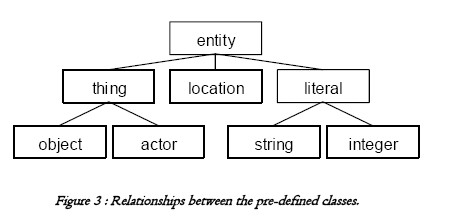 The "examine.i" file says:...ADD TO EVERY THINGISexaminable.searchable.END ADD TO THING....Every OBJECT, then, as a THING, is by default "examinable" and "searchable" (we will look at the "search" statement later). The SYNONYMS for "examine" include "x" (the common IF convention for "examine"), "inspect", and " 'check' " (see the information below on using Alan reserved programming words). Any of these words typed by the player will be the same to the interpreter as though the player had typed "examine".Now there is something new here:...SYNTAXexamine = 'look' 'at' (obj) *....We will look at the SYNTAX construction in detail later. What is important to see at this point is that this is not the same as a single-word SYNONYM for "examine". This SYNTAX construction allows for a multiple-word command, "look at", applied to the OBJECT (obj), meaning the same thing to the interpreter as "examine"....Add To Every thingVerb examineCheck obj Is examinableElse"You can't examine" Say The obj. "."Does"There is nothing special about" Say The obj. "."End Verb.End Add To....Finally we come to the command itself. Every OBJECT, as a THING, will respond to the command, or VERB, "examine", according to this section of code in "examine.i". First the interpreter will CHECK if the OBJECT (obj) has the Attribute ("Is") "examinable". Then, passing that CHECK, the interpreter DOES the action of the VERB, which in this case is to respond, "There is nothing special about" and then Say The OBJECT. And so:TV RoomThis is your favorite room in the house, because you love to watch television. You recently purchased a giant screen plasma TV that is set up in this room, ideally located across from your comfy chair and table. The kitchen is south.> look at the tvThere is nothing special about the TV.> look at the chairThere is nothing special about the comfy chair.> look at the tableThere is nothing special about the table.Changing the Default ResponseWe can change the "nothing special" response with one of our own for each of our OBJECTS. The simplest way to do that right now is to begin with the "copy-and-paste" method. Let's copy and paste the VERB from "examine.i" into our OBJECTS. This is the section we want from "examine.i":Verb examineCheck obj Is examinableElse"You can't examine" Say The obj. "."Does"There is nothing special about" Say The obj. "."End Verb.The only part we need is the VERB statement, and what it DOES. So before we paste it into our game file, let's remove the CHECK, etc.Important: This doesn't mean the CHECKS will not apply to our OBJECTS. The CHECKS will still be applied by default.Verb examineDoes"There is nothing special about" Say The obj. "."End Verb.We can also remove the unwanted response, leaving us with:Verb examineDoes""End Verb.Now let's paste this into the section for each of our OBJECTS:...SYNONYMStelevision = tv.THE tv Isa OBJECT AT tv_roomNAME TV NAME plasmaNAME screen NAME giantNAME giant screen plasma tvIS SWITCHABLE.HAS weight 100.DESCRIPTIONVerb examineDoes""End Verb.END THE tv.-----------------------THE chair Isa OBJECT AT tv_roomNAME comfy chair NAME comfyDESCRIPTIONVerb examineDoes""End Verb.END THE chair.-----------------------THE table Isa OBJECT AT tv_roomDESCRIPTIONVerb examineDoes""End Verb.END THE table.-----------------------...Now let's put in our custom responses:...SYNONYMStelevision = tv.THE tv Isa OBJECT AT tv_roomNAME TV NAME plasmaNAME screen NAME giantNAME giant screen plasma tvIS SWITCHABLE.HAS weight 100.DESCRIPTIONVerb examineDoes"It's your 52-inch plasma pride and joy."End Verb.END THE tv.-----------------------THE chair Isa OBJECT AT tv_roomNAME comfy chair NAME comfyDESCRIPTIONVerb examineDoes"It's your favorite chair to sit in when you're watching the big game."End Verb.END THE chair.-----------------------THE table Isa OBJECT AT tv_roomDESCRIPTIONVerb examineDoes"It's an ordinary table, set conveniently by your chair."End Verb.END THE table.-----------------------...Save, compile and run the game. "Look at" the TV.TV RoomThis is your favorite room in the house, because you love to watch television. You recently purchased a giant screen plasma TV that is set up in this room, ideally located across from your comfy chair and table. The kitchen is south.> look at the tvThere is nothing special about the TV. It's your 52-inch plasma pride and joy.We still got the default response and our custom response. What happened?Note what was said above about the CHECK. Even though we removed it from the VERB for each of our OBJECTS, the CHECK is still carried out by the default VERB in the "examine.i" file. The same holds true for the DOES. The default DOES in the library is carried out, and then the custom DOES for the OBJECT is carried out.If we want the interpreter to do only what the custom response calls for, we add the word ONLY. Like this:...Verb examineDoes ONLY"It's your 52-inch plasma pride and joy."End Verb....Include the word "ONLY" in each of the custom VERB responses for the tv, chair, and table. Compile and play the game, examining each. The game will display only the custom responses!
Reserved words
-
Reserved words Reserved WordsNotice the single-quotes around the word "check", as well as the words "look" and "at", in "examine.i". This is very important! We know that CHECK and AT are reserved Alan programming words, or keywords. When the Alan program sees a CHECK or any Alan keyword, it tries to understand it as a statement, which will most likely result in a compiler error. But that does not preclude us from using Alan keywords for our own purposes. The single-quotes around the keyword will protect it from being interpreted as a statement, and will allow its use as though it were not a keyword.
Another Take on "take"
-
Another Take on "take" Another Take on "take"Previously we worked with various default responses for the "take" command, using the tv as our test OBJECT. First we made the tv "NOT takeable", resulting in the default response:> take the tvYou can't take that!Then we gave the tv the Attribute of weight, and gave it a weight of 100.> take the tvThat is too heavy to lift.There is still another way to override the default responses for "take", and that is to supply a custom response of our own, as we did in the last section with the "examine" VERB. Let's copy and paste the relevant section from the "take" VERB in "take.i":Verb take, pick_up1, pick_up2Check obj Is takeableElse "You can't take that!"And obj Not In wornElse "You've already got that - you're wearing that."And obj Not In heroElse "You've already got that."And weight Of obj <=50Else "That is too heavy to lift."DoesLocate obj In hero."Taken."End Verb.Let's remove the CHECKS and paste the remaining code in the tv OBJECT....SYNONYMStelevision = tv.THE tv Isa OBJECT AT tv_roomNAME TV NAME plasmaNAME screen NAME giantNAME giant screen plasma tvIS SWITCHABLE.-- We removed the "HAS weight 100" to keep the-- default CHECK from stopping the "take" action.DESCRIPTIONVerb examineDoes ONLY"It's your 52-inch plasma pride and joy."End Verb.Verb take, pick_up1, pick_up2Does ONLY -- We don't want the default DOES to apply!Locate obj In hero."Taken."End Verb.END THE tv....Look at the line that says "Locate obj In hero." The LOCATE statement is new. Its purpose is to move or locate an OBJECT or ACTOR (including the player character, if we wish) from one place to another. The place can be a LOCATION, a CONTAINER, near another OBJECT, etc., depending on other factors.In this case the "take" action will LOCATE the tv (obj) "In hero." The Hero is the default player character, and is also the default player's inventory CONTAINER. That is, anything carried by the Hero (the player character) is said to be IN the Hero. So to LOCATE the tv IN the Hero means that the tv will no longer be in the TV Room, but be carried by the player character.To prevent the tv from being moved into the player inventory, we simply omit the LOCATE statement from the "take" VERB....Verb take, pick_up1, pick_up2Does ONLY"Taken."End Verb....The default LOCATE will not apply because it is in the DOES section of the default VERB. We are overriding everything in the DOES section of the default VERB with DOES ONLY.Of course the "Taken" message makes no sense now. We can put a custom message in its place....SYNONYMStelevision = tv.THE tv Isa OBJECT AT tv_roomNAME TV NAME plasmaNAME screen NAME giantNAME giant screen plasma tvIS SWITCHABLE.DESCRIPTIONVerb examineDoes ONLY"It's your 52-inch plasma pride and joy."End Verb.Verb take, pick_up1, pick_up2Does ONLY"You try to wrap your arms around the giant screen but it is too wide. You can't get a good grip on the heavy TV to lift it."End Verb.END THE tv....In effect, we have stopped the action by overriding the default response. This same effect could be achieved with a CHECK in the place of the DOES ONLY, but I prefer this method as it allows greater flexibility as the program becomes more complex. Turn It On
-
Turn It On Turn It OnLet's do one more custom response to a default VERB in the library, turning the tv on and off. We'll start by looking once again at "turn.i" and copying what we need for the tv and removing the CHECKS.Verb turn_on1, turn_on2, switch_on1, switch_on2DoesMake obj 'on'."You turn on" Say The obj. "."End Verb.Remember at this point in the "take" VERB (previous section) we came to the LOCATE statement after the DOES. This time we have come to something else new in the line "Make obj 'on'."The MAKE statement changes a Boolean Attribute.The MAKE statement does not Add an Attribute, but changes it. The OBJECT in question must already have the Attribute, either that it IS, or IS NOT. As noted before, a Boolean Attribute can be thought of in terms of on/off, yes/no. The MAKE statement is used to turn the on to off, the yes to no, the right_side_up to upside_down, etc. It does so by making the ON to NOT ON, the YES to NOT YES, the RIGHT_SIDE_UP to NOT RIGHT_SIDE_UP, and so on, and vice versa.We had to give the tv the Attribute "IS SWITCHABLE" so that the player can turn it on or off. But we did not have to give the tv the Attribute of " 'on' " (an Alan reserved word), because it already has it. That is, the tv has the Attribute IS NOT 'ON'. We did not have to assign that Attribute to the tv in our code, because the default library ("turn.i") has already assigned it to every OBJECT in the game:Add To Every objectIsNot 'on'.Not switchable.End Add To object.What an OBJECT IS NOT can be changed to IS, and what it IS can be changed to IS NOT, with the MAKE statement.Verb turn_on1, turn_on2, switch_on1, switch_on2DoesMake obj 'on'."You turn on" Say The obj. "."End Verb.So the line "Make obj 'on' " will change the Attribute of the tv from NOT ON to ON. In fact, it will MAKE the tv ON two times: once in the default library and once in our VERB for the tv. Once we add the DOES ONLY, however, we override everything in the default DOES, and it will only be changed in the local VERB for the tv.A further bit of house cleaning comes into play here, however. The word "obj" is a stand-in for the OBJECT, in this case the tv. It will work fine as it is, making the tv ON. But to make the code easier to understand, especially as it may become more complex, we do well to let the tv stand in for itself.Verb turn_on1, turn_on2, switch_on1, switch_on2Does ONLYMake tv 'on'."You turn on" Say The obj. "."End Verb.Finally we will write our custom message response. We could say "You turn on the tv," but that would be the very same message as the default library. If that is all we wanted, we would have done well enough to assign the IS SWITCHABLE Attribute to the tv and be done. The default library would take care of the rest.But we want to do more than say "You turn on the tv." We want this display:> turn on the tvWow! What a great picture! You watch the game and your favorite team wins!And so have you...*** You have won! ***Do you want to UNDO, RESTART, RESTORE or QUIT?
PART FOUR: Images and Text Formattimg
-
PART FOUR: Images and Text Formattimg The SHOW and QUIT Statements
-
The SHOW and QUIT Statements SHOW and QUITIt is very easy to put images in your game with the SHOW statement. Here is how it is done for the tv:...SYNONYMStelevision = tv.THE tv Isa OBJECT AT tv_roomNAME TV NAME plasmaNAME screen NAME giantNAME giant screen plasma tvIS SWITCHABLE.DESCRIPTIONVerb examineDoes ONLY"It's your 52-inch plasma pride and joy."End Verb.Verb take, pick_up1, pick_up2Does ONLY"You try to wrap your arms around the giant screen but it is too wide.You can't get a good grip on the heavy TV to lift it."End Verb.Verb turn_on1, turn_on2, switch_on1, switch_on2Does ONLYMake tv 'on'."Wow! What a great picture!"SHOW 'plasma.jpg'."You watch the game and your favorite team wins!""$pAnd so have you...""$p*** You have won! *** " -- The customary IF "win" messageQUIT.End Verb.END THE tv....The format for the SHOW statement is the same as that for the IMPORT statement we did earlier. The name of the .jpg file must be enclosed in single-quotes and the statement must end with a full-stop. It is also important to note that the image file must be in the same folder as the game source file when you compile it.The "plasma.jpg" is included in the download of this tutorial. Save it in your game folder to use as you follow this beginner's guide.You will not need to include the image file with the a3c game file (produced by the compiler) when you distribute your game, but you will need to include the a3r file (also produced by the compiler), which holds the media for your game.QUIT (with a full-stop) is all that we need for the "undo, restart, restore, or quit" message. QUIT is a built-in Alan statement (and reserved word) that does it all for us.The "$p" characters are formatting characters and will be explained in the next section. A START AT Formatting
-
A START AT Formatting A START AT FormattingWhen starting a game of Interactive Fiction, some sort of introductory information and title is usually displayed before the player is introduced to the first LOCATION. We might wish, for example, to start our game with this display:*** TV TIME! ***An ALAN 3 Interactive Fiction Tutorial GameBy Michael Arnaud © 2006(Type "help" if you have not played this kind of game before.)Joy of joys, you have just purchased a brand new big screen plasma TV that was delivered earlier today!TV RoomThis is your favorite room in the house, because you love to watch television. You recently purchased a giant screen plasma TV that is set up in this room, ideally located across from your comfy chair and table. The kitchen is south.>Re-Introducing START ATWe place our introductory information and title conveniently after the START AT statement....START AT tv_room."$p$t$t$t$t$t$t$t$t$t*** TV TIME! ***$n$t$t$t$t$t$tAn ALAN 3 Interactive Fiction Tutorial Game$n$t$t$t$t$t$t$tBy Michael Arnaud © 2006$p(Type ""help"" if you have not played this kind of game before.)$pJoy of joys, you have just purchased a brand new big screen plasma TV that was delivered earlier today!"We Love Those Dollar $igns!There are some odd-looking figures here... $p, $n, $t. They have nothing to do with dollars (too bad). They are simple text-formatting symbols, that do the following:$p -- "paragraph" Prints a blank line to the screen and then begins a new line of text.$n -- "new" Begins a new line of text without first printing a blank line.$t -- "tab" Inserts a tab.(There is more of this in the manual, ¶ 4.16.1). Formatting like this is important throughout our game. It helps in creating lists, conversation, and general appearance and readability of the text.Note that these formatting symbols are within the double-quotes, immediately and without spaces, with the text we want to display. These symbols can be placed at the beginning, end, middle, or anywhere we want the formatting to occur. The compiler does not care about full-stops or returns, sentences or paragraphs in our display statements within double-quotes. So to force a line-break ($n) or paragraph ($p), etc., we use these formatting symbols.Note that we put double-quotes at the beginning ("$p$t$t$t$t$t$t$t$t$t*** TV TIME! ***) and did not close the double-quotes until the end ( ...delivered earlier today!"). That is because the enitre section of code is one block of uninterrupted text to be displayed. But we could have just as well put double-quotes in a more logical and easy-to-read way. Like this:"$p$t$t$t$t$t$t$t$t$t*** TV TIME! ***""$n$t$t$t$t$t$tAn ALAN 3 Interactive Fiction Tutorial Game""$n$t$t$t$t$t$t$tBy Michael Arnaud © 2006""$p(Type ""help"" if you have not played this kind of game before.)""$pJoy of joys, you have just purchased a brand new big screen plasma TVthat was delivered earlier today!"Either of these layouts will print the same information to the screen. Just remember: for every open double-quote there must be a close! Compiler errors will surely result from failure to observe this rule, and not just one, but dozens of inexplicable errors! -- from a misplacement, omission or otherwise bad use of double-quotes. For this reason, I prefer the single-block quote: the fewer double-quotes, the better.NOTE: Anyime you compile a game and get a lot of errors seemingly out of nowhere, the first thing to look for is a problem with double-quotes. (The next thing is a misplaced or missing full-stop.)Using Double-Quotes and Double Double-QuotesNow notice the DOUBLE double-quotes around the word: ""help"". ALAN 3 already uses double-quotes to tell the compiler to "say" things to the player, that is, to print it to the screen. So if we were to just use double-quotes within the double-quotes like this "help" we would confuse the compiler (which is never a very nice thing to do). We will get a result we don't like, and very likely a compiler error.We can still display double-quotes for conversation and such, by DOUBLE double-quotes. These are read by the compiler to print a single set of double-quotes to the screen, just the way we want.The compiler has no problem with single-quotes and other figures within the double-quote marks. Notice for example the use of asterisks above.Formatting with ImagesThe Alan interpreter displays images at the left margin. As of this writing, there is no method for displaying images, say, in the center or at the right margin. The formatting of text around the image is a little tricky, and trial-and-error is probably the best method to get the display you want.If you want to display text not only above and below, but to the right of the image, I have found this format effective:..."Wow! What a great picture!"SHOW 'plasma.jpg'."$n$nYou watch the game and your favorite team wins!""$$n$nAnd so have you...""$p*** You have won! *** "...The $n or double $n will print the text to the right of the image, where using a $p would force the text to the line after the image, i.e., below it.Change the Starting LOCATION DESCRIPTIONNow that we have given introductory information at the start that the player has "just purchased a brand new big screen plasma TV that was delivered earlier today," it is redundant to repeat that same information in the TV Room. It's time to change the TV Room DESCRIPTION.THE tv_room Isa LOCATIONNAME 'TV Room'DESCRIPTION"This is your favorite room in the house, because you love to watch television. Your new plasma TV is set up in this room, ideally located across from your comfy chair and table.$pThe kitchen is south."...While we're at it, since we have added a few adjectives to the tv in our start-up information, let's go back to the tv and add them as well, just in cast the player wants to refer to the tv with them....SYNONYMStelevision = tv.THE tv Isa OBJECT AT tv_roomNAME TV NAME plasma NAME brand NAME newNAME screen NAME giantNAME brand new giant screen plasma tv...
PART FIVE: A First Puzzle
-
PART FIVE: A First Puzzle A Puzzling Problem
-
A Puzzling Problem A Too-Easy WinThere is not much challenge to our game. Turn on the tv and win the game. Challenges and obstacles often add fun to games; and overcoming obstacles -- "puzzles," in IF vernacular -- may even be the whole point of the game. Even so, it is well to make puzzle-solving part of a larger story, and not simply a matter of solving one puzzle after another.Suppose we introduce a few puzzles for turning on the tv. Our first puzzle might be a simple matter of having to find the remote control by searching the chair, in order to turn on the tv.When we construct puzzles it is a good idea to work them in the reverse order of solving them. That is, whatever the player must do last, we should program first, and so on. The order of construction, then, should be first to disable turning on the tv without the remote; second, to create and enable the remote to turn on the tv; and third, searching the chair and finding the remote control.Disable the TV...Verb turn_on1, turn_on2, switch_on1, switch_on2Does ONLY-- We removed MAKE tv 'on'."There are no knobs, switches or buttons for turning on the TV."End Verb....This overrides the default response from the library with a message explaining why the TV cannot be turned on. There is also an implied hint that there must be some other way to turn it on, and it is likely to come to the mind of the player to look for a remote control. If we are concerned that the puzzle may be too difficult, we could add a line something like "Perhaps there is a remote control somewhere." But in this case I think the player will not need that much of a hint.Create the RemoteTHE remote Isa OBJECT AT NowhereNAME remote control NAME controllerNAME tv control remoteVERB examineDOES ONLY"It's a very simple push-button remote control."END VERB.END THE remote.Notice that the remote is "AT Nowhere". That is because it will not be introduced into the game proper until it is found by searching the chair.Enable the RemoteLooking once again to the library for the "turn on" VERB in "turn.i":Verb turn_on1, turn_on2, switch_on1, switch_on2Check obj Is switchableElse "You can't turn that on."And obj Is Not 'on'Else "It's already on."DoesMake obj 'on'."You turn on" Say The obj. "."End Verb.So first thing we will make the remote "switchable".THE remote Isa OBJECT AT NowhereNAME remote control NAME controllerNAME tv control remoteIS SWITCHABLE....Remove the CHECKS from the VERB and add DOES ONLY:Verb turn_on1, turn_on2, switch_on1, switch_on2Does ONLYMake obj 'on'."You turn on" Say The obj. "."End Verb.Now notice this: "obj" is a stand-in for the remote. We don't really want to turn on the remote. We want the statement "turn on the remote" to turn on the tv and win the game. So:THE remote Isa OBJECT AT NowhereNAME remote control NAME controllerNAME tv control remoteIS SWITCHABLE.VERB examineDOES ONLY"It's a very simple push-button remote control."END VERB.Verb turn_on1, turn_on2, switch_on1, switch_on2Does ONLYMake tv 'on'."Wow! What a great picture!"SHOW 'plasma.jpg'."$n$nYou watch the game and your favorite team wins!""$n$nAnd so have you...""$p*** You have won! *** "QUIT.End Verb.END THE remote.Searching Is Not ExaminingThis is still an occasional matter of debate on the Interactive Fiction newsgroups. Some say that if you are examining something, you are ipso facto searching it as well. Others maintain that "examine", or "x", has become a convention in IF meaning only to "look at", not to search in detail. This opinion appears to be that of the majority, and is mine as well. It is also the way the Alan standard library is set up.From "examine.i":ADD TO EVERY THINGISexaminable.searchable.END ADD TO THING....The chair is a THING, so it is "searchable"....VERB searchCHECK obj IS searchableELSE"You can't search" Say The obj. "."DOES"You find nothing of interest."END VERB.Remove the CHECKS and add DOES ONLY:VERB searchDOES ONLY"You find nothing of interest."END VERB.Now let's change the default message.VERB searchDOES ONLY"You find the lost remote control."END VERB.Now bring the remote into the game.VERB searchDOES ONLYLOCATE remote Here."You find the lost remote control."END VERB.We can use "Here" to represent the LOCATION where the Hero is. It is helpful especially in such cases if, for example, the player were to take the chair into the kitchen before searching it. If we were to code it this way it would give a rather confusing result:VERB searchDOES ONLYLOCATE remote AT tv_room. -- But we're in the kitchen!?"You find the lost remote control."END VERB.An even better solution than "LOCATE remote Here" whenever the Hero finds a small OBJECT, is to assume that the player would take it upon finding it, and LOCATE the OBJECT IN the Hero, with an explanatory message.VERB searchDOES ONLYLOCATE remote in Hero."You find the lost remote control, which you take."END VERB.Hint, HintIt is probably a good idea to give the player a subtle hint to search the chair. A good place to do that is in the "examine" VERB for the chair.VERB examineDOES ONLY"It's your favorite chair to sit in when you're watching the big game.It has big soft comfy cushions -- just the kind people lose change in all the time."END VERB.By suggesting that there may be some loose change under the cushions, it is likely that the astute player will search the chair. It might be a good idea to add the cushions to the NAME of the chair....THE chair Isa OBJECT AT tv_roomNAME comfy chair NAME comfyNAME cushionsNAME big soft chair cushion -- includes singular and pluralDESCRIPTION...Compile and play what we have so far. If you have typed everything correctly, you should have a basic working game that includes searching the chair and turning on the remote to win the game. Fine Tune and Finish
-
Fine Tune and Finish Fine TuneThe game "works," that is, the mechanics work properly. Now it is time to fine tune it, so that the game plays easily and makes sense for the game world. Let's start by tuning up the remote control.We have told the player via the VERB "examine" that the remote is a "push-button" remote. It would be reasonable for the player then to refer to the buttons, and to push or press the buttons to operate the remote. There are several ways we could accommodate these actions by the player. We could program the buttons separately, which might add to the realism. But we should also weigh how much realism and detail for such things as the buttons on the remote control is necessary.For our purposes, we will not program the buttons as a separate OBJECT, but simply include them as part of the remote with NAME statements.THE remote Isa OBJECT AT NowhereNAME remote control NAME controllerNAME remote NAME button NAME simple push buttons...The next thing to do is accommodate the player's likely attempt to "push the button". A look at "push.i" in the library tells us the remote needs to have the Attribute "IS PUSHABLE." Then we are ready to copy and paste the VERB, removing the CHECKS and adding DOES ONLY:THE remote Isa OBJECT AT NowhereNAME remote control NAME controllerNAME remote NAME button NAME simple push buttonsIS SWITCHABLE.PUSHABLE.Verb pushDoes ONLY"You push" Say The obj. "."End Verb....Further fine tuning at this point means we should put ourself in the place of the player and ask, What else might it be reasonable for the player to try with the remote or the button? And the answer would surely include "press the button" and "click the remote".But we have no VERB in the library for "press"! Or "click"! What do we do now?Before we get to that, we ought to consider that there might well be other OBJECTS in the game that the player may try to "press" or "click" as well as "push". To accommodate the VERB to multiple OBJECTS in the game, we are going to make changes to the library, albeit a safe and simple one using SYNONYMS.And so we have come to the reason why I said at the beginning to copy the standard library for use in the game, and to keep the original library in a separate folder on the computer.Remember, the changes are done to your copy of the standard library in your "mylib" folder, not the "alanlib" folder.Some of the changes we will make in the future may be considerable; but for now it will be a very safe and simple one. The changes are indicated in RED. Any time we make changes to the library, it is a good idea to add notes (indicated in this tutorial with *** ) so the changes can be easily identified.-- push.i-- Library version 0.5.0-- 0.4.1 - converted to ALANv3ADD TO EVERY THINGISpushable.END ADD TO THING.SYNONYMSpress, click = push. -- *** ADDED ***SYNTAXpush = push (obj)WHERE obj ISA THINGELSE "You can't push that."Add To Every objectVerb pushCheck obj Is pushableElse "You can't push that."Does"You push" Say The obj. "."End Verb.End Add To....Now "press the button" or "click the remote" will work the same as "push the button". All we need to do now is make the VERB do what we want (i.e., win!) and the fine-tuning for the remote is complete.THE remote Isa OBJECT AT NowhereNAME remote control NAME controllerNAME control remote NAME remoteNAME button NAME simple push buttonsIS SWITCHABLE.PUSHABLE.VERB examineDOES ONLY"It's a very simple push-button remote control."END VERB.VERB turn_on1, turn_on2, switch_on1, switch_on2DOES ONLYMAKE tv 'on'."Wow! What a great picture!"SHOW 'plasma.jpg'."$n$nYou watch the game and your favorite team wins!""$n$nAnd so have you...""$p*** You have won! *** "QUIT.END VERB.VERB pushDOES ONLYMAKE tv 'on'."Wow! What a great picture!"SHOW 'plasma.jpg'."$n$nYou watch the game and your favorite team wins!""$n$nAnd so have you...""$p*** You have won! *** "QUIT.END VERB.END THE remote.Search and Search AgainNow let's turn our fine-tuning attentions to the chair. Once the player searches the chair and discovers the remote, he/she might continue to search the cushions for the lost change we suggested they might find. What we don't want them to find is this:> x chairIt's your favorite chair to sit in when you're watching the big game. It has big soft comfy cushions -- just the kind people lose change in all the time.>search chairYou find the lost remote control, which you take.>iYou are carrying a remote control.>search chairYou find the lost remote control, which you take.Here is one way we might prevent that from happening:...VERB searchCHECK remote AT NowhereELSE"There is nothing else to find by searching the chair."DOES ONLYLOCATE remote in Hero."You find the lost remote control, which you take."END VERB....If the player has not found the remote, it will still be "AT Nowhere". The CHECK will pass, and the DOES ONLY will LOCATE the remote IN the Hero. But once the remote has been found, it will no longer be "AT Nowhere" and the CHECK message will explain "there is nothing else to find".Televisions Need Fine-TuningOur tv needs fine-tuning, in that even after the player has found the remote control, he/she cannot "turn on the tv"! We can easily fix that in the same way as we fine-tuned the "search" VERB for the chair....VERB turn_on1, turn_on2, switch_on1, switch_on2CHECK remote HereELSE"There are no knobs, switches or buttons for turning on the TV."DOES ONLYMAKE tv 'on'."Wow! What a great picture!"SHOW 'plasma.jpg'."$n$nYou watch the game and your favorite team wins!""$n$nAnd so have you...""$p*** You have won! *** "QUIT.END VERB....Notice that the preventive message we previously had in the DOES ONLY for the tv has been moved into the CHECK. If the CHECK passes, that is, if the remote control is "Here" (in the same LOCATION or in the player's Inventory), then the DOES ONLY executes, and the game is won.We could have made it so that the remote control has to be held by the player, in other words, "CHECK remote IN Hero". The player would then have to "get remote" before turning on the tv. But IF players prefer that if the required OBJECT is in the same LOCATION, the "get" action should be assumed and done for them. So we require only that the remote is "Here".NOTE that we do not write it, "CHECK remote IS Here" or "CHECK remote IS IN Hero". Being "Here" or "IN Hero" is not an Attribute!This completes our first "simple" game. Compile and Play It!
-
Compile and Play It! ------------------------------------------------- *** TV TIME! ***-- An ALAN 3 Interactive Fiction Tutorial Game-- By Michael Arnaud © 2006-----------------------------------------------IMPORT 'std.i'.-----------------------THE tv_room Isa LOCATIONNAME 'TV Room'DESCRIPTION"This is your favorite room in the house, because you love to watch television.Your new plasma TV is set up in this room, ideally located across from your comfy chair and table.$pThe kitchen is south."EXIT south TO kitchenDOES"You go south, into the kitchen."END EXIT.EXIT north, east, west TO tv_roomCHECK"There is only a wall in that direction."END EXIT.END THE tv_room.-----------------------THE remote Isa OBJECT AT NowhereNAME remote control NAME controllerNAME control remote NAME remoteNAME button NAME simple push buttonsIS SWITCHABLE.PUSHABLE.VERB examineDOES ONLY"It's a very simple push-button remote control."END VERB.VERB turn_on1, turn_on2, switch_on1, switch_on2DOES ONLYMAKE tv 'on'."Wow! What a great picture!"SHOW 'plasma.jpg'."$n$nYou watch the game and your favorite team wins!""$n$nAnd so have you...""$p*** You have won! *** "QUIT.END VERB.VERB pushDOES ONLYMAKE tv 'on'."Wow! What a great picture!"SHOW 'plasma.jpg'."$n$nYou watch the game and your favorite team wins!""$n$nAnd so have you...""$p*** You have won! *** "QUIT.END VERB.END THE remote.-----------------------SYNONYMStelevision = tv.THE tv Isa OBJECT AT tv_roomNAME TV NAME plasma NAME brand NAME newNAME screen NAME giantNAME brand new giant screen plasma tvIS SWITCHABLE.DESCRIPTIONVERB examineDOES ONLY"It's your 52-inch plasma pride and joy."END VERB.VERB take, pick_up1, pick_up2DOES ONLY"You try to wrap your arms around the giant screen but it is too wide.You can't get a good grip on the heavy TV to lift it."END VERB.VERB turn_on1, turn_on2, switch_on1, switch_on2CHECK remote HereELSE"There are no knobs, switches or buttons for turning on the TV."DOES ONLYMAKE tv 'on'."Wow! What a great picture!"SHOW 'plasma.jpg'."$n$nYou watch the game and your favorite team wins!""$n$nAnd so have you...""$p*** You have won! *** "QUIT.END VERB.END THE tv.-----------------------THE chair Isa OBJECT AT tv_roomNAME comfy chair NAME comfyNAME cushions NAME big soft chair cushionDESCRIPTIONVERB examineDOES ONLY"It's your favorite chair to sit in when you're watching the big game.It has big soft comfy cushions -- just the kind people lose change in all the time."END VERB.VERB searchCHECK remote AT NowhereELSE"There is nothing else to find by searching the chair."DOES ONLYLOCATE remote in Hero."You find the lost remote control, which you take."END VERB.END THE chair.-----------------------THE table Isa OBJECT AT tv_roomDESCRIPTIONVERB examineDOES ONLY"It's an ordinary table, set conveniently by your chair."END VERB.END THE table.-----------------------THE kitchen Isa LOCATIONNAME 'Kitchen'DESCRIPTION"This is the kitchen. North returns to the TV Room."EXIT north TO tv_roomDOES"You return to the TV Room, north."END EXIT.EXIT south, east, west TO kitchenCHECK"There is only a wall in that direction."END EXIT.END THE kitchen.-----------------------START AT tv_room."$p$t$t$t$t$t$t$t$t$t*** TV TIME! ***$n$t$t$t$t$t$tAn ALAN 3 Interactive Fiction Tutorial Game$n$t$t$t$t$t$t$tBy Michael Arnaud © 2006$p(Type ""help"" if you have not played this kind of game before.)$pJoy of joys, you have just purchased a brand new big screen plasma TV that was delivered earlier today!"
PART SIX: CONTAINERS and Classes
-
PART SIX: CONTAINERS and Classes CONTAINERS
-
CONTAINERS CONTAINERSIs That an Open Container, Son?There are all sorts of OBJECTS in Interactive Fiction that are CONTAINERS: boxes and baskets, bowls and cups and bottles; of course these are CONTAINERS, as well as cabinets, drawers, trash cans, and so on. Many CONTAINERS can be opened and/or closed, locked or unlocked, transparent (such as a wine glass) or not (such as a lead-lined box), empty or with contents inside.Our game "TV Time!" will have several CONTAINERS, one of which we have already created but not yet given the CONTAINER property. No, it's not the chair. Even though we will later program the chair for sitting in, the chair is not a CONTAINER. In fact, neither the Hero nor any Actor (NPC, or "non-player character") can be inside a CONTAINER. The proto-CONTAINER in our game is the table....THE table Isa OBJECT AT tv_roomDESCRIPTIONVERB examineDOES ONLY"It's an ordinary table, set conveniently by your chair."END VERB.END THE table....Oh yes, right now it is only "an ordinary table". But it is about to be transformed with a single word....THE table Isa OBJECT AT tv_roomCONTAINERDESCRIPTIONVERB examineDOES ONLY"It's an ordinary table, set conveniently by your chair."END VERB.END THE table....And just like that (snap!) it is done. Note that being a CONTAINER is not an Attribute. (Though it can be one of the non-Boolean sort if we wish, with "HAS CONTAINER". That will not be covered in this guide.)Now the player can "put <something> in" the table or "take <something> from" it. Try it, if you like.Each of these VERBS requiring a CONTAINER is covered in the library. But our table does not have any drawers or anything to put something inside. Our table is a simple surface, and all we want is to be able to put something on the table (and take from it). Nevertheless, in order to understand what we are going to do with the "put on" VERB, we will first have to understand the "put in" VERB, from "put.i":SYNTAXput_in = put (obj1) 'in' (obj2)WHERE obj1 ISA OBJECTELSE "You can't put that anywhere."AND obj2 ISA CONTAINERELSE "You can't put anything in that."Sin Tax?As you can see, the construction of a VERB becomes more complex when it involves not just one, but two or more OBJECTS. In this case we have two OBJECTS, represented by obj1 and obj2. It is important to figure out which is the CONTAINER and which is being "put in" the CONTAINER.The SYNTAX statement defines which is which: obj1 ISA OBJECT and obj2 ISA CONTAINER. We can think of the SYNTAX statement as that which defines the parameters of the VERB. It tells us the exact wording of the VERB. The single word "put_in" that is used by the VERB equals the two player-input words "put" and "'in'" (another Alan reserved word) in regards to the OBJECT and the CONTAINER.The SYNTAX statement also often acts as a CHECK. It will not allow the VERB if the parameters defined by the SYNTAX statement are not met. If the obj1 is not an OBJECT or if the obj2 is not a CONTAINER, the SYNTAX will inform the player that "You can't put...", etc.The put_in VERBAdd To Every objectVerb put_inWhen obj1Check obj1 In heroElse"You haven't got" Say The obj1. "."And obj1 <> obj2Else "You can't put something into itself!"And obj2 <> heroElse "You can't put" Say obj1. "into yourself!"DoesLocate obj1 In obj2."Done."End Verb.End Add To.Notice that the VERB is in reference to obj1, the OBJECT to be put in the CONTAINER. There are two clues to this. First, the library is Adding To Every object, not To Every CONTAINER. Second, and the main indicator, the line after "Verb put_in" says "When obj1"."When" can be translated to mean, "When you want to do this to", in this case, "when you want to put this obj1 in something." If the line were to read instead, "When obj2", it would mean, "when you want to put something in this obj2." We are going to use "When obj2" in just a moment, but for now let's look at the VERB as it is in the library.The next lines CHECK whether the Hero has the obj1 in his/her Inventory. Again, I prefer to accommodate the player if the obj1 is present in the same LOCATION. So let's change the library VERB to allow that.Add To Every objectVerb put_inWhen obj1Check obj1 Here -- *** CHANGED FROM In Hero, etc. ***Else"You don't see" Say The obj1. "here."And obj1 <> obj2Else "You can't put something into itself!"And obj2 <> heroElse "You can't put" Say obj1. "into yourself!"DoesLocate obj1 In obj2."Done."End Verb.End Add To.The two "And" statements act as two more CHECKS to the VERB, preventing the player from putting something into itself or into their self. Finally there is the "Does", which LOCATES the obj1 IN the obj2.The put_on VERBThe library ("put.i") has the "put on" VERB:...Syntax...put_on = put (obj1) 'on' (obj2)Where obj1 Isa objectElse "You can't put that anywhere."And obj2 Isa thingElse "You can't put anything on that."...The library SYNTAX has set the parameters for the "put on" VERB for obj1 as an OBJECT and obj2 as a THING. This works for us, because a CONTAINER is an OBJECT, and an OBJECT is a THING.The reason obj2 is a THING and not a CONTAINER is to allow the player to put <something> on himself/herself, i.e., to wear it. See "wear.i" in the library....THE table Isa OBJECT AT tv_roomCONTAINERDESCRIPTIONVERB examineDOES ONLY"It's an ordinary table, set conveniently by your chair."END VERB.VERB put_onWHEN obj2DOES ONLYLOCATE obj1 IN table."You set" Say The obj1. "on the table.""END VERB.END THE table....Making the VERB Not Work for the TableThere is a VERB that we do not want to apply to the table, and that is the "put in" VERB. Our table has no drawers to put anything into. So:...THE table Isa OBJECT AT tv_roomCONTAINERDESCRIPTIONVERB examineDOES ONLY"It's an ordinary table, set conveniently by your chair."END VERB.VERB put_onWHEN obj2DOES ONLYLOCATE obj1 IN table."You set" Say The obj1. "on the table.""END VERB.VERB put_inWHEN obj2CHECK"There are no drawers in the table to put anything in."END VERB.END THE table....WHEN obj2 equals "WHEN you want to put something in this table" (see note above). The VERB hits the CHECK and displays the explanation. There are no drawers in the table to put anything in.If on the other hand there were another CONTAINER in the game (perhaps a big box), it would be possible to "put the table in the box". The WHEN obj2 only CHECKS and stops the VERB when the table is being used as the CONTAINER. The player could not "put the box in the table". But he/she could "put the box on the table".What Does a Surface "Contain"?When "examined" or otherwise described, CONTAINERS will describe their contents as well (unless programmed not to do so) with the default message, "The <CONTAINER> contains <its contents>." So if the player were for example to "put the remote on the table", this would be the result:> x the tableIt's an ordinary table, set conveniently by your chair.> put the remote on the tableDone.> x the tableIt's an ordinary table, set conveniently by your chair. The table contains a remote control.We can change the "contains" message to better fit the table, which after all is a surface. To do this, we add a HEADER statement....THE table Isa OBJECT AT tv_roomCONTAINERHEADER"Resting on the table is"DESCRIPTIONVERB examineDOES ONLY"It's an ordinary table, set conveniently by your chair."END VERB.VERB put_onWHEN obj2DOES ONLYLOCATE obj1 IN table."You set" Say The obj1. "on the table.""END VERB.VERB put_inWHEN obj2CHECK"There are no drawers in the table to put anything in."END VERB.END THE table....Which gives the desired result:> x the tableIt's an ordinary table, set conveniently by your chair. Resting on the table is a remote control. Classes
-
Classes SURFACES
-
SURFACES A Classy SurfaceIn the previous section we made the table into a CONTAINER, and further refined it to be a special kind of CONTAINER, a surface. Our game has several of these surface-type CONTAINERS. Instead of having to program the same Attributes and VERBS for each one, we can create a Sub-Class with the shared Attributes, etc. (¶ 2.4.5) , and call it SURFACE (or "Topside" or "Pimpernel" or whatever we want).Every SURFACE Isa OBJECTCONTAINERHEADER"Resting on top is"VERB examineDOES ONLY -- override default "nothing special" messageLIST THIS.END VERB....Two things to notice here. One, we don't want the default "nothing special" message from the library VERB, so we use DOES ONLY. Second, we can use "THIS" to good effect in creating Classes. It represents the particular subject of the VERB -- in this case the particular SURFACE in question....VERB put_inWHEN obj2CHECK"That isn't something you can put anything ""in""."END VERB.END EVERY.Perhaps you wonder why we do not include the "put_on" VERB for the Surface Class, since that is the main thing we want the player to be able to do. The answer is that "put on" serves as well for clothing etc. that the player might want to "put on" or "wear". It would become complicated and tedious to make wearable items into Containers; it is easier simply to implement "put on" for the particular Instances of Surfaces.Now that we have created a specialized Class of OBJECT-CONTAINER, we can use it for the table and for every other similar OBJECT in the game....THE table Isa SURFACE AT tv_roomDESCRIPTIONVERB examine DOES BEFORE"It's an ordinary table, set conveniently by your chair."END VERB....Here is something else new: DOES BEFORE. We do not want to override the DOES ONLY statement in the Class, but we do want to amend something before the Class's "examine" DOES its action. The Class VERB will LIST the contents of the Container; the Instance (i.e. the table) will print the "ordinary table" message BEFORE the Class LISTS what is on top.There is also the DOES AFTER statement, for when we want some action to occur after the Class and/or default DOES of the library VERB....END THE table....This is the power of "object oriented programming": the ability to create Classes for whole ranges of specialized OBJECTS, ACTORS and LOCATIONS will make it much easier to program, for example, multiple Indoor LOCATIONS with walls, floor, etc., without having to program them for each one; Outdoor LOCATIONS with sky, birds, grass, etc.; Doors; Teleporters; Lockables; Forests; all sorts of things that might occur to our imagination. CLOSEABLES
-
CLOSEABLES An Open and Shut CaseThere is another sort of specialized CONTAINER we might find useful (though there will be only one of these in our short game), one that can be opened and closed. This would be used for cabinets, treasure chests, drawers, knapsacks, secret compartments, etc. I like to call them CLOSEABLES, and here is how we create a Class for them:Every CLOSEABLE Isa OBJECT...Right off we have a conflict with the library file "open.i". In that file there are VERBS for "open" and "close", that CHECK for IS OPENABLE and IS CLOSEABLE respectively. With CLOSEABLE as a Class as well as an Attribute, we are using the same word to mean two different things to the computer, which could cause problems. One remedy of course would be to call our specialized CONTAINER Class something else, like OPEN_CLOSER.But I prefer to change the library; to use the single Attribute IS OPENABLE for both the "open" and "close" VERBS. After all, I figure if something is closeable it is probably also openable; and if we should need to create an unusual OBJECT that is closeable but not openable (such as a latching lock box to which the player does not have the key), we can MAKE it NOT OPENABLE in its own "close" VERB.This frees CLOSEABLE for exclusive use as a Class. So in "open.i" we make these changes:...Add To Every object-- *** REMOVED Is Not closeable. ***Verb closeCheck obj Is OPENABLE -- *** CHANGED from closeable ***Else "You can't close that."And obj Is openElse "It is not open."DoesMake obj Not open.Say The obj. "is now closed."End Verb.End Add To.With that resolved, let's return to creating our CLOSEABLE Class.Every CLOSEABLE Isa OBJECTOPAQUE CONTAINER...An OPAQUE CONTAINER is one that the player cannot see into, that is, what it contains while it is closed. If we want a CLOSEABLE that the player can see into while closed, we can omit or change the OPAQUE Attribute to make it transparent.Every CLOSEABLE Isa OBJECTOPAQUE CONTAINERHEADER -- For when it is open"It contains"IS OPENABLE. -- see "open.i"VERB open DOES AFTER...This is just like the DOES BEFORE statement. We don't want to override the default DOES in the library, but we do want to add something after the default "open" DOES its action. The library VERB will MAKE the CLOSEABLE Attribute "Is open" and display the message that it is open.All we want to do is cause the CLOSEABLE to describe its contents after it has been opened. DOES AFTER accomplishes this for us.Every CLOSEABLE Isa OBJECTOPAQUE CONTAINERHEADER"It contains"IS OPENABLE.VERB open DOES AFTERMAKE THIS NOT OPAQUE....MAKE THIS NOT OPAQUE so that it will reveal its contents and make them accessible to the player....VERB open DOES AFTERMAKE THIS NOT OPAQUE.LIST THIS.END VERB....The LIST statement will cause THIS (particular CLOSEABLE) to describe its contents.Now it is a simple matter to do the same for the "close" VERB....VERB close DOES AFTER -- the default is in "open.i"MAKE THIS OPAQUE.END VERB.END EVERY.Just in case you're wondering where to put this code, it might be a good idea to put your custom Classes right after the " import 'std.i.' ":------------------------------------------------- *** TV TIME! ***-- An ALAN 3 Interactive Fiction Tutorial Game-- By Michael Arnaud © 2006-----------------------------------------------IMPORT 'std.i'.------------------------- *** CUSTOM CLASSES: ***Every SURFACE Isa OBJECTCONTAINERHEADER"Resting on top is"VERB examineDOES ONLYLIST THIS.END VERB.VERB put_inWHEN obj2CHECK"That isn't something you can put anything ""in""."END VERB.END EVERY.-----------------------Every CLOSEABLE Isa OBJECTOPAQUE CONTAINERHEADER"It contains"IS OPENABLE.VERB open DOES AFTERMAKE THIS NOT OPAQUE.LIST THIS.END VERB.VERB close DOES AFTERMAKE THIS OPAQUE.END VERB.END Every.-----------------------...Some or all of the custom Classes you create might be useful for other games that you write as well. You can accumulate these in a file in your custom library instead of in your game file (as above). Call the file something like "custom.i" and put it in the library folder. Then open "std.i" and add "import 'custom.i'." to the list.Let's go ahead and put this Class and the SURFACE Class to use in the Kitchen:...-----------------------THE kitchen Isa LOCATIONNAME 'Kitchen'DESCRIPTION"This is the kitchen. There is a counter and a cupboard here.$pNorth returns to the TV Room."EXIT north TO tv_roomDOES"You return to the TV Room, north."END EXIT.EXIT south, east, west TO kitchenCHECK"There is only a wall in that direction."END EXIT.END THE kitchen.-----------------------THE counter Isa SURFACE AT kitchenDESCRIPTIONEND THE counter.-----------------------THE cupboard Isa CLOSEABLE AT kitchenNAME cupboard NAME cabinetDESCRIPTIONEND THE cupboard.-----------------------Try it and see how you can put OBJECTS like the remote control on the counter, you can open and close the cupboard, or put the remote in the cupboard and close it, etc. Everything works for the counter and cupboard because they "inherit" the Attributes and VERBS from their respective Classes (see ¶ 4.5.1). DOORS
-
DOORS Alan Manual v3.0 Preliminary DoorsThough not as popular in Interactive Fiction as in times past, the Door is still a useful fixture between LOCATIONS. It is not much used in games anymore as a simple inconvenience between LOCATIONS (as it is in our tutorial game), but if there are Doors they are usually either integral to the story, and/or they are a puzzle (locked by key or password, etc.), often used to progress the game after certain conditions are met.Most doors have two sides, in which case it is necessary to program two Doors, one in each LOCATION to represent the two sides of a single Door. Here is how we might construct a Door Class:EVERY Door Isa OBJECTNAME door...Notice that the NAME statement can be inherited. Every particular Instance of a Door will be called a Door, inherited from the Class, as well as any other NAME(S) we might add in the Instance.The following table from the manual (without the manual's nice colors, see ¶ 4.7.1) shows how the NAME as well as other properties are inherited by the Instances. Some are completely overridden, that is, the property if included in the Instance will replace that of the Class. Others are accumulated (as the NAME statement for example), generally appending to the end of the same property in the Class.Inherited Property Initial location Overridden Name Accumulated, the inherited names are appended at the end of the list of Name clauses Pronoun Overridden, each pronoun clause inhibits inheriting pronouns from the parent class. Attribute values Overridden, attribute declarations using the same name as an inherited can give the attribute a different value but must match the type of the inherited.
Accumulated, you can add further attributes in a class or instance.Initialize Accumulated. Inherited initialize clauses are executed first so that the base classes may do their initialization first. Description check Accumulated. Description Overridden. Articles & Forms Overridden. Mentioned Overridden. Also overrides names. Container Overridden, all clauses are overridden. Verb declarations Accumulated. Verb bodies are accumulated for verbs with the same name as the inherited. Use qualifiers (see Verb Qualification on page 99) if you don't want them all to execute. Scripts Overridden, for same script name. Entered Overridden. Exits Overridden, for same direction. EVERY Door Isa OBJECTNAME doorHAS otherside Door....The point of this line is to indicate the other side of the Door, i.e, first that it HAS the non-Boolean Attribute of an "otherside", and then to assign the Class, "Door" to that other side. So every Door has an other side which is also a Door.EVERY Door Isa OBJECTNAME doorHAS otherside DoorIS OPENABLE. -- So we can open and close it.VERB openDOES AFTERMAKE otherside OF THIS open.END VERB.The execution of the "open" VERB, after the action of the default DOES to open the Door, will change the Attribute of the Door's other side (which is also a Door) to OPEN. The result is similar for the "close" VERB:VERB closeDOES AFTERMAKE otherside OF THIS NOT open.END VERB.END EVERY.And here is how we implement "a door" between the TV Room and the Kitchen. Note that it is really two doors, the tv_door and the kitchen_door, each having the other as its "otherside". The EXITS have been modified to CHECK that the door is open.-----------------------THE tv_room Isa LOCATIONNAME 'TV Room'DESCRIPTION"This is your favorite room in the house, because you love to watch television.Your new plasma TV is set up in this room, ideally located across from your comfy chair and table.$pThe door to the kitchen is south."EXIT south TO kitchenCHECK tv_door IS OPENELSE"$t$t<BUMP>$p$t$tOof!$pThe door is closed."DOES"You go south, into the kitchen."END EXIT.EXIT north, east, west TO tv_roomCHECK"There is only a wall in that direction."END EXIT.END THE tv_room.-----------------------THE tv_door Isa Door AT tv_roomHAS otherside kitchen_door.END THE tv_door.-----------------------THE kitchen_door Isa Door AT kitchenHAS otherside tv_door.END THE kitchen_door.-----------------------THE kitchen Isa LOCATIONNAME 'Kitchen'DESCRIPTION"This is the kitchen. There is a counter and a cupboard here.$pNorth returns to the TV Room."EXIT north TO tv_roomCHECK kitchen_door IS OPENELSE"$t$t<BUMP>$p$t$tOof!$pThe door is closed."DOES"You return to the TV Room, north."END EXIT.EXIT south, east, west TO kitchenCHECK"There is only a wall in that direction."END EXIT.END THE kitchen.-----------------------
IF-THEN
-
IF-THEN IF - THEN (¶ 4.16.7)We have previously used the CHECK statement as a conditional statement. If certain conditions are met, then the CHECK passes and the action continues. If the conditions are not met, the CHECK stops the action that would otherwise take place and displays an explanatory message.VERB do_this, do_thatCHECK conditions are metELSE "You can't do that!"DOES"You do this and that."END VERB.There is another conditional statement in the ALAN language. Actually it is a pair of statements, IF and THEN. There are basically two differences between CHECK and IF-THEN. One, unlike the CHECK statement that allows or stops the DOES statement, the IF-THEN statement follows the DOES statement. Two, CHECK only allows or stops the action, where IF-THEN does not stop the action, but can execute from among multiple actions according to the conditions.One way to demonstrate the IF-THEN statement is in a VERB format.VERB do_this, do_thatDOESIF condition "A" is metTHEN "You do action A."END IF.END VERB.The power of the IF-THEN statement increases with the IF-THEN-ELSE combination.VERB do_this, do_thatDOESIF condition "A" is metTHEN "You do action A."ELSE"You do action B."END IF.END VERB.-- and --VERB do_this, do_thatDOESIF condition "A" is metTHEN "You do action A."ELSIF condition "B" is metTHEN "You do action B."ELSE"You do action C."END IF.END VERB.For every "IF" statement there must be an "END IF."The IF-THEN statement will prove to be very useful in all sorts of ways. It can even be used in LOCATION DESCRIPTIONS to describe changing conditions. For example:THE field Isa LOCATIONNAME 'Grassy Field'DESCRIPTION"You are standing in an open field. The sky is"IF weather IS RAINYTHEN"heavy with thunder clouds."ELSIF weather IS FOGGYTHEN"hidden in the fog. You can barely see three feet ahead of you."ELSE"clear and blue."END IF.... PART SEVEN: A Second Puzzle
-
PART SEVEN: A Second Puzzle A PLUG for the GAME
-
A PLUG for the GAME A Plug for Our GameLet's continue building on our game by making it necessary to plug the tv cord into an electrical outlet in the wall. Coding the game in reverse order of solving the puzzle, we need to disable the remote (and tv). Then we will create the cord, then the wall and outlet.Disable the RemoteWe need to keep in mind (or better yet write down somewhere) what we will call the power cord and how we will signal to the remote that it is plugged in. In this case we will call the cord, the "cord", and we will have the remote CHECK if the cord "IS PLUGGED_IN".-----------------------THE remote Isa OBJECT AT NowhereNAME remote control NAME controllerNAME control remote NAME remoteNAME button NAME simple push buttonsIS SWITCHABLE.PUSHABLE.VERB examine DOES ONLY"It's a very simple push-button remote control."END VERB.VERB turn_on1, turn_on2, switch_on1, switch_on2CHECK cord IS PLUGGED_INELSE"The TV won't turn on. It isn't getting any power."DOES ONLYMAKE tv 'on'."Wow! What a great picture!"SHOW 'plasma.jpg'."$n$nYou watch the game and your favorite team wins!""$n$nAnd so have you...""$p*** You have won! *** "QUIT.END VERB.VERB pushCHECK cord IS PLUGGED_INELSE"The TV won't turn on. It isn't getting any power."DOES ONLYMAKE tv 'on'."Wow! What a great picture!"SHOW 'plasma.jpg'."$n$nYou watch the game and your favorite team wins!""$n$nAnd so have you...""$p*** You have won! *** "QUIT.END VERB.END THE remote.-----------------------Disable the tv in the same way:SYNONYMStelevision = tv.THE tv Isa OBJECT AT tv_room...VERB turn_on1, turn_on2, switch_on1, switch_on2CHECK remote HereELSE"There are no knobs, switches or buttons for turning on the TV."AND cord IS PLUGGED_INELSE"The TV won't turn on. It isn't getting any power."DOES ONLYMAKE tv 'on'."Wow! What a great picture!"SHOW 'plasma.jpg'."$n$nYou watch the game and your favorite team wins!""$n$nAnd so have you...""$p*** You have won! *** "QUIT.END VERB....The Power CordTHE cord Isa OBJECT AT tv_roomIn the game the cord will be made to appear as part of the tv. The easiest way to do that is in the "examine" and other VERBS, rather than trying to code the tv as a CONTAINER just to hold the cord, and then to prevent all other properties of the CONTAINER, and to prevent removing the cord, etc.THE cord Isa OBJECT AT tv_roomNAME cord NAME power electric electrical tv cordDESCRIPTIONIS PLUGGABLE.NOT PLUGGED_IN.We are just making up these Attributes, trying to think of terms that will suit the "plug in" VERB we will create in a moment. Before we get to that, let's customize the library VERBS "examine" and "take".THE cord Isa OBJECT AT tv_roomNAME cord NAME power electric electrical tv cordDESCRIPTIONIS PLUGGABLE.NOT PLUGGED_IN.VERB examineDOES ONLY"The power cord is of the common sort, and just three feet long."IF cord IS PLUGGED_INTHEN"It is plugged into the electric outlet."END IF.END VERB.Here you can see how the IF-THEN statement can be used to modify the response to the "examine" VERB. The cord is first described, then the IF looks to see whether the cord is plugged in. If so, the THEN displays that information to the player.VERB take, pick_up1, pick_up2CHECK"You can't take it. The power cord is permanently attached to the television set."END VERB.END THE cord. Creating Custom VERBS
-
Creating Custom VERBS Create the "plug in" VERBThis is the first VERB we have needed that is not already done for us in the library. We previously solved this for "press" and "click" (in this section) by making them SYNONYMS for the library "push" VERB. It would be very easy and perhaps plausible to do the same thing here, to make "plug" a SYNONYM for "put". When the player would type ">plug cord in outlet" it would be the same to the computer as though they had typed ">put cord in outlet".But it would probably be best to create the "plug in" VERB on its own so that we can check for "pluggability"; we don't necessarily want other "puttable" OBJECTS to be "pluggable" as well. Besides, you are doubtless going to need to create a VERB sometime, you may as well learn how to do it now.The Alan manual is the best place to learn all the technical ins and outs of SYNTAX and VERBS. It would be good to read and understand that material to better understand what we are doing here. But I will keep the technical ins and outs to a minimum here. Our method of creating VERBS will be to "steal" them from the library. Heh heh.We have already been doing that in order to create custom responses; now we are going to do it for the whole VERB. I have hinted that the "plug in" VERB we want to create will be very similar to the "put in" VERB in the library. That is the first thing to look for when creating a VERB.Somewhere in the library you will be able to find a VERB that is very similar to the one you have in mind. Find it, copy it, and adapt it."One step at a time" is one of Thomas Nilsson's favorite maxims, and we would do well to follow it here. The first step is to make a new file called "plug.i". Save the file in the library folder. The next step is to open "std.i" and to include this line in the list of ".i" files there (if you miss this step then "plug.i" will not be imported into your game):IMPORT 'plug.i'.Now open the "plug.i" and the "put.i" files. Most text editors (such as Crimson Editor) will allow you to open multiple files and give you easy access and switching between them. Copy all of "put.i" and paste it into "plug.i". Now before you make any changes, close the "put.i" file. You don't want to accidentally make changes to the wrong file!I have indicated below in red the changes to adapt "plug.i" for our VERB.-- put.i CHANGE TO -- plug.i (Try a Universal Replace of "plug" for "put"!)-- Library version 0.5.2 OMIT-- 0.4.1 - converted to ALANv3 OMITSYNONYMSplace = put. CHANGE TO insert = plug.SYNTAX OMIT this whole SYNTAX statement, we don't need "plug" by itself.put = put (obj) *WHERE obj ISA OBJECTELSE "You can't put that anywhere."Add To Every object OMIT this whole Add To, same reason.VERB putCHECK obj IN HEROELSE "You haven't got that."DOESLOCATE obj HERE."Dropped."END VERB.End Add To.SYNTAXput_in = put (obj1) 'in' (obj2) plug_in = plug (obj1) 'in' (obj2)WHERE obj1 ISA OBJECTELSE "You can't put that anywhere." ELSE "You can't plug that anywhere."AND obj2 ISA CONTAINERELSE "You can't put anything in that." ELSE "You can't plug anything in that."Add To Every objectIS NOT PLUGGABLE.NOT PLUGGED_IN.Verb put_in Verb plug_inWhen obj1Check obj1 HereElse"You don't see" Say The obj1. "here."AND obj1 IS PLUGGABLEELSE "That isn't something that can be plugged in."AND obj1 IS NOT PLUGGED_INELSE "That is already plugged in."And obj1 <> obj2Else "You can't put something into itself!" ...plug something into itself!"And obj2 <> heroElse "You can't put" Say obj1. "into yourself!" ...plug" Say obj1...DoesLocate obj1 In obj2.MAKE obj1 PLUGGED_IN."Done."End Verb.End Add To.OMIT all the rest. We won't need "plug near", "plug behind", "plug on" or "plug under".Here it is with the changes.-- plug.iSYNONYMSinsert = plug.SYNTAXplug_in = plug (obj1) 'in' (obj2)WHERE obj1 ISA OBJECTELSE "You can't plug that anywhere."AND obj2 ISA CONTAINERELSE "You can't plug anything in that."Add To Every objectIS NOT PLUGGABLE.NOT PLUGGED_IN.Verb plug_inWhen obj1Check obj1 HereElse"You don't see" Say The obj1. "here."AND obj1 IS PLUGGABLEELSE "That isn't something that can be plugged in."AND obj1 IS NOT PLUGGED_INELSE "That is already plugged in."And obj1 <> obj2Else "You can't plug something into itself!"And obj2 <> heroElse "You can't plug" Say obj1. "into yourself!"DoesLocate obj1 In obj2.MAKE obj1 PLUGGED_IN."Done."End Verb.End Add To.The player may wish to "unplug" the cord as well. Let's include that in "plug.i".Syntaxunplug = unplug (obj)Where obj Isa objectElse "You can't unplug that!"Add To Every objectVerb unplugCheck obj Is PLUGGABLEElse "You can't unplug that!"And obj IS PLUGGED_INElse "It is already unplugged."DoesLocate obj in Hero.MAKE obj NOT PLUGGED_IN."Unplugged."End Verb.End Add To.Syntaxunplug_from = unplug (obj) 'from' (holder)Where obj Isa objectElse "You can only unplug objects."And holder Isa ContainerElse "You can't unplug things from that!"Add To Every objectVerb unplug_fromWhen objCheck obj Is PLUGGABLEElse "You can't unplug that!"And obj IS PLUGGED_INElse "It is already unplugged."And obj In holderElseSay The obj. "is not there."DoesLocate obj In hero.MAKE obj NOT PLUGGED_IN."You unplug" Say The obj. "."End Verb.End Add.The Cord Is FinishedWe have made the cord PLUGGABLE and NOT PLUGGED_IN. The new default "plug in" and "unplug" VERBS will take care of those statements should the player want to try them.Practice
-
Practice PracticeNow would be a good time to practice creating your own VERBS, copying them from the library and adapting them to do what you want.Some VERBS do not require OBJECTS to act upon. The player could laugh, for example, without having to laugh at anything. See what you can do to create the "laugh" VERB. You can search the library for the SYNTAX and VERBS that you need. Here's a hint: jump.Once you have done that, create the "laugh at" VERB (also from "jump.i"). The "obj" should probably be a THING, not only an OBJECT, just in case the player might want to laugh at an ACTOR (which is also a THING). Remember that "AT" is an Alan reserved word.SitThere is a nice comfy chair in the TV Room. Create a "sit in" VERB in the library and implement it for the chair. Don't forget to make an Attribute to CHECK for "sittability" (I use IS SITABLE) and add it to the chair (as done in Compile and Play It!) .PullHere is a VERB that is not in the standard library but might be useful in many games. Use "push.i" as your model. Create "pull.i" in the library, using the careful procedure described in this section. Include SYNONYMS, SYNTAX, VERBS, CHECKED Attributes, etc.SolutionsDon't read this section further until you have completed the practice above.SOLUTIONS-- laugh *** from "jump.i" ***SYNTAXlaugh = laugh.VERB laughDOES"Ha ha hah!"END VERB.------------------------- laugh at *** also from jump.i ***SYNTAXlaugh_at = laugh 'at' (obj)WHERE obj ISA THINGELSE "You can't laugh at that!"Add To Every thingVERB laugh_atDOES"You laugh at " Say The obj. ". Hah hah hah!"END VERB.End Add To.------------------------- pull.i *** from push.i ***SYNONYMSdrag, yank = pull.SYNTAXpull = pull (obj)WHERE obj ISA THINGELSE "You can't push that."Add To Every objectVerb pullCheck obj Is MOVEABLE -- Already ADDED TO EVERY OBJECT in "push.i"Else "You can't pull that."Does"You pull" Say The obj. "."End Verb.End Add To.Syntaxpull_with = pull (obj1) 'with' (obj2)Where obj1 Isa thingElse "You can't pull that."And obj2 Isa objectElse "You can use only objects to pull things with."Add To Every objectVerb pull_withWhen obj1Check obj1 IS MOVEABLEElse "You can't pull that."Does"Using" Say The obj2. "you pull" Say The obj1. "."End Verb.End Add To.-----------------------Advanced Attribute ChangesIt seems to me that it isn't necessary to have separate Attributes for "push" and "pull", IS PUSHABLE and IS PULLABLE respectively. It makes two Attributes instead of one for every thing in the game that we might want to make moveable or not moveable by pushing and/or pulling. I prefer to change the required library Attribute to IS MOVEABLE for both "push" and "pull". As always, be mindful of the changes you make to the library. Cardinal Rules
-
Cardinal Rules Another New Global VERBMany Interactive Fiction games generally allow the player to move northeast, northwest, southeast, southwest as well as in the four cardinal directions. We have limited travel in our game, however, to the four cardinal directions.We can create a global "nodirection" VERB that will take care of the off-cardinal directions without having to code for them in every LOCATION.-- nowhere.i-- Library version 0.5.0-- 0.4.1 - converted to ALANv3SYNONYMSn = north.s = south.e = east.w = west.-- ne = northeast. -- *** COMMENTED OUT ***-- se = southeast.-- nw = northwest.-- sw = southwest.-- Useful for placing disappearing things-- Also defines the default directionsTHE nowhere ISA LOCATION.EXIT north TO nowhere.EXIT south TO nowhere.EXIT west TO nowhere.EXIT east TO nowhere.-- EXIT northeast TO nowhere. -- *** COMMENTED OUT ***-- EXIT southeast TO nowhere.-- EXIT northwest TO nowhere.-- EXIT southwest TO nowhere.EXIT up TO nowhere.EXIT down TO nowhere.END THE nowhere.SYNONYMSne,northeast,se,southeast,nw,northwest,sw,southwest = nodirection.The player is exceedingly unlikely to type "nodirection", but this word stands in for all the others. So if the player types "northeast" or "sw", it will be the same to the computer as though they had typed "nodirection".SYNTAXnodirection = nodirection.VERB nodirectionDOES"The only directions you'll need in this game arenorth, south, east, west, up, down, in, and out. "END VERB.Notice that we did not just delete the unwanted directions, but "commented" them out. That is because in other games we may want to include some or all of those other directions. We will only need to "un-comment" the ones we want and rewrite the SYNONYMS statement for "nodirection" to reflect that change.
The WALL Isa Scenery
-
The WALL Isa Scenery Hitting the WallWe have already mentioned the walls in the TV Room and Kitchen. Should the player try to go in directions that don't go from one LOCATION to the other, they will get the message:There is only a wall in that direction.Let's create the wall, after which we will create the electrical outlet in the wall.THE tv_wall...We will differentiate between the wall(s) in the TV Room and in the Kitchen.THE tv_wall Isa Scenery AT tv_room...What "Isa Scenery"?"Scenery" is the only default Class in the standard library. Let's take a look at it in "scenery.i":-- scenery.i-- Library version 0.5.0Every scenery Isa objectIsNot searchable.Not takeable.Not pushable.Not touchable.Verb examine, takeDoes Only"That's only scenery."End Verb.End Every scenery.Pretty basic stuff here. The Scenery Class prevents searching, taking, pushing or even touching certain OBJECTS in the game. This Class is often used for peripheral OBJECTS that promote the atmosphere and realism of the game, but are not meant for any further interaction. The only VERB implemented for Scenery is "examine" (the "take" is precluded by the IS NOT TAKEABLE Attribute!).I for one prefer to explain to the player why something cannot be searched, etc. Let's change the Scenery Class to do that.Every scenery Isa objectDESCRIPTION -- *** ADDED. It should be in the default! ***-- *** REMOVED:-- Is-- Not searchable.-- Not takeable.-- Not pushable.-- Not touchable.Verb examine -- *** REMOVED take ***Does -- *** REMOVED Only, to allow "examine" in Instances ***"That's only scenery."End Verb.-- *** ADDED VERBS: ***VERB searchCHECK -- Prevent any default DOES responses!"There is nothing to find by searching that."END VERB.VERB take, pick_up1, pick_up2CHECK"There is no need to take that. You won't need it."END VERB.VERB pushCHECK"There is no need to push that."END VERB.VERB touchCHECK"There's no need to touch or to feel that."END VERB.End Every scenery.Other Classes of SceneryYou might consider making other Classes of Scenery to include in "scenery.i". For example, a Far_Scene Class could be created for OBJECTS that are too far away to touch, get, etc.EVERY Far_Scene Isa OBJECTDESCRIPTIONVERB take, pick_up1, pick_up2CHECK"That is too far away to reach from here."END VERB.-- etc. --END Every.I will leave that to you and your imagination. The Outlet in the Wall
-
The Outlet in the Wall Finish Building the WallTHE tv_wall Isa SCENERY AT tv_roomNAME wall NAME wallsVERB examineDOES ONLY"One wall in particular has an electric outlet."END VERB.END THE tv_wall.The Electrical OutletThe outlet is part of the wall. As explained for the power cord and the tv (here), there is no need to make the wall into a CONTAINER for the sake of holding the outlet. We need only describe the outlet as being part of the wall and code the VERB responses accordingly. The outlet, however, will have to be a CONTAINER for the power cord to "plug in" to (refer to the "plug in" VERB here).Everything here has been covered in this guide to this point:THE outlet Isa SCENERY AT tv_roomNAME outlet NAME electrical electric power wall wallplugCONTAINERHEADER ""VERB examineDOES ONLY"It's a three-prong electrical outlet."IF cord IS PLUGGED_INTHEN"The TV cord is plugged into it."END IF.END VERB.VERB plug_in, put_in -- The player might try "put plug in outlet"WHEN obj2 -- (see this section)CHECK obj1 IS PLUGGABLEELSE"Hey, be careful! That doesn't go into an electrical outlet!"AND cord IS NOT PLUGGED_INELSE"The cord is already plugged in!"...Not What Was Expected...DOES ONLYMAKE cord PLUGGED_IN."You put the power cord snugly into the electrical outlet."END VERB.END THE outlet.-----------------------Some explanation is needed here. The default VERB is in reference to obj1, not to obj2 ("plug.i"):...Verb plug_inWhen obj1-- CHECKS RemovedDoesLocate obj1 In obj2.MAKE obj PLUGGED_IN."Done."End Verb....We are using the VERB for the outlet as obj2, the CONTAINER.VERB plug_in, put_inWHEN obj2...There are no default CHECKS for the VERB WHEN obj2 (nor is there a default DOES). That is why the CHECKS for the VERB had to be coded here.Note that we did not code our DOES ONLY to "Locate obj1 In obj2." That is not necessary, since we are using the cord, not the outlet, to test whether the cord is plugged in the outlet (see here). The test (CHECKED by the remote control/tv) is whether the cord IS or IS NOT PLUGGED_IN. So all we need to do in our DOES ONLY statement is to "MAKE cord PLUGGED_IN" and to tell the player it is done.This makes it easier as well to program for:"Plug in the tv"We have allowed for the player to type ">plug in the cord", but what if the player types ">plug in the tv"? It is a simple matter to make the tv PLUGGABLE (implemented in Compile and Play It!). And that is all we have to do. Note again the "plug_in" VERB for the outlet. If obj2 (like the tv) IS PLUGGABLE, then it makes the cord PLUGGED IN.Back to the WallRemember this important question to ask ourselves: "What else might the player try?" We want to avoid making the player "guess the verb." Put yourself in their place and you guess as the author what other reasonable things they might try to do. It seems to me that the player might reasonably be expected to try:> plug the cord in the wallNot to worry. Let's look at what we have for the wall so far.THE tv_wall Isa SCENERY AT tv_roomNAME wall NAME wallsVERB examineDOES ONLY"One wall in particular has an electric outlet."END VERB.END THE tv_wall.Since we want the same VERB to apply for the wall in the very same way as for the outlet, all we have to do is copy the VERB for the wall and make sure the wall will pass the CHECKS.THE tv_wall Isa SCENERY AT tv_roomCONTAINER -- Required for the wall to be obj2HEADER ""NAME wall NAME wallsVERB examineDOES ONLY"One wall in particular has an electric outlet."IF cord IS PLUGGED_INTHEN"The TV cord is plugged into it."END IF.END VERB.VERB plug_in, put_inWHEN obj2CHECK obj1 IS PLUGGABLEELSE"Hey, be careful! That doesn't go into an electrical outlet!"AND cord IS NOT PLUGGED_INELSE"The cord is already plugged in!"DOES ONLYMAKE cord PLUGGED_IN."You put the power cord snugly into the electrical outlet."END VERB.END THE tv_wall.-----------------------This completes the puzzle. The remote control will not work, the tv cannot be turned on, unless the cord is plugged in. The player can plug the cord into the outlet, even if they type it as "plug the cord in the wall."
PART EIGHT: A Third Puzzle
-
PART EIGHT: A Third Puzzle Setting a New Stage
-
Setting a New Stage Alan Manual v3.0 Preliminary Setting a New StageSince we have said in the game that the tv was "just delivered today", let's change the start of the game with the tv still inside its packing carton. The player will have to cut the carton open with a knife from the kitchen (in the cupboard we created in a previous section), plug in the cord and turn on the tv with the remote control.It no longer makes sense to have the remote control lost in the chair cushions. Let's start with the remote in the carton with the tv. But we will put a battery for the remote control in the chair.The Battery In the Cushion-----------------------THE battery Isa OBJECT AT Nowhere -- until found in the chairVERB examineDOES ONLY"It's a regular household AAA battery."END VERB.END THE battery.-----------------------THE chair Isa OBJECT AT tv_roomNAME comfy chair NAME comfyNAME cushions NAME big soft chair cushionDESCRIPTIONVERB examineDOES ONLY"It's your favorite chair to sit in when you're watching the big game.It has big soft comfy cushions -- just the kind people lose change in all the time."END VERB.VERB searchCHECK battery AT NowhereELSE"There is nothing else to find by searching the chair."DOES ONLYLOCATE battery in Hero."You find a small battery, which you take."END VERB.END THE chair.-----------------------CHECK the Remote for the Battery-----------------------THE remote Isa OBJECT AT NowhereNAME remote control NAME controllerNAME control remote NAME remoteNAME button NAME simple push buttonsOPAQUE CONTAINER -- so you can put the battery in itIS SWITCHABLE.PUSHABLE.VERB examineDOES ONLY"It's a very simple push-button remote control."END VERB.VERB put_inWHEN obj2CHECK obj1 = batteryELSE"Don't be silly. Only a battery goes in there!"DOES AFTER"You snap the battery into place in the remote."END VERB....We want to allow only the battery to be put it in the remote control. It is a simple matter to CHECK that obj1 is the battery....VERB turn_on1, turn_on2, switch_on1, switch_on2CHECK battery IN remoteELSE"Pushing the button on the remote, nothing happens.The remote won't do anything without a battery."LOCATE remote IN Hero. -- Assumes remote is "Taken".AND cord IS PLUGGED_INELSE"The TV won't turn on. It isn't getting any power."DOES ONLYMAKE tv 'on'."Wow! What a great picture!"SHOW 'plasma.jpg'."$n$nYou watch the game and your favorite team wins!""$n$nAnd so have you...""$p*** You have won! *** "QUIT.END VERB.VERB pushCHECK battery IN remoteELSE"Pushing the button on the remote, nothing happens.The remote won't do anything without a battery."LOCATE remote IN Hero. -- Assumes remote is "Taken".AND cord IS PLUGGED_INELSE"The TV won't turn on. It isn't getting any power."DOES ONLYMAKE tv 'on'."Wow! What a great picture!"SHOW 'plasma.jpg'."$n$nYou watch the game and your favorite team wins!""$n$nAnd so have you...""$p*** You have won! *** "QUIT.END VERB.END THE remote.-----------------------The TV In the Box-----------------------SYNONYMStelevision = tv.THE tv Isa OBJECT AT Nowhere -- until box is opened...VERB turn_on1, turn_on2, switch_on1, switch_on2CHECK remote HereELSE"There are no knobs, switches or buttons for turning on the TV."AND battery IN remoteELSE"Pushing the button on the remote, nothing happens.The remote won't do anything without a battery."LOCATE remote IN Hero. -- Assumes remote is "Taken".AND cord IS PLUGGED_INELSE"The TV won't turn on. It isn't getting any power."DOES ONLYMAKE tv 'on'."Wow! What a great picture!"SHOW 'plasma.jpg'."$n$nYou watch the game and your favorite team wins!""$n$nAnd so have you...""$p*** You have won! *** "QUIT.END VERB....-----------------------THE cord Isa OBJECT AT Nowhere -- it's part of the tv, rememberNAME cord NAME power electric electrical tv cordDESCRIPTIONIS PLUGGABLE.NOT PLUGGED_IN.VERB examineDOES ONLY"The power cord is of the common sort, and just three feet long."IF cord IS PLUGGED_INTHEN"It is plugged into the electric outlet."END IF.END VERB.VERB take, pick_up1, pick_up2CHECK"You can't take it. The power cord is permanently attached to the television set."END VERB.END THE cord.----------------------The Box Before Opening-----------------------SYNONYMScarton, crate = box.THE box Isa OBJECT AT tv_roomNAME packing carton NAME heavy cardboard boxNAME label NAME large black lettersNAME upward pointing arrowHAS weight 500. -- too heavy to liftDESCRIPTIONVERB examineDOES ONLY"It's quite large, about five feet square. Besides the label (""UltimoPlasma TV""), there are large black letters that say, ""PUSH WITHCARE"".$nAn upward pointing arrow indicates ""THIS SIDE UP"".""$pThe box is sitting by a wall."END VERB.END THE box.-----------------------The Knife In the Cupboard-----------------------THE knife Isa OBJECT IN cupboard...Notice the starting place for the knife is not "AT" but "IN" the cupboard CONTAINER.THE knife Isa OBJECT IN cupboardVERB examineDOES ONLY"It's a sturdy, sharp knife."END VERB.END THE knife.-----------------------The TV Room DESCRIPTION Revisited-----------------------THE tv_room Isa LOCATIONNAME 'TV Room'DESCRIPTION"This is your favorite room in the house, because you love to watch television.Besides your comfy chair and table,"IF tv HereTHEN"your new plasma TV is here."ELSE"there is a large cardboard packing carton here."END IF."$pThe door to the kitchen is south."EXIT south TO kitchenCHECK tv_door IS OPENELSE"$t$t<BUMP>$p$t$tOof!$pThe door is closed."DOES"You go south, into the kitchen."END EXIT.EXIT north, east, west TO tv_roomCHECK"There is only a wall in that direction."END EXIT.END THE tv_room.----------------------- The Cutting Edge
-
The Cutting Edge Alan Manual v3.0 Preliminary The Cutting EdgeAll the parts are in place. The tv and remote control are in the box. The battery is hidden in the chair cushions. The knife is in the kitchen cupboard. Now we have to make the parts work together to solve the puzzle.We have already programmed most things to do what they are meant to do. But we have introduced the packing carton, which must be cut open with the knife.IMPORTANT: For Which OBJECT?It may sometimes be confusing for which OBJECT to implement the VERB to complete a given task. For example, should we implement the "cut open" VERB for the knife or for the box?1 - Look for the OBJECT that is changed by the action. That is often the result you will want to CHECK for in the progress of the game. Here the box is changed, the knife is not.2 - Look for the OBJECT that needs the other to do the action, i.e., the "passive" OBJECT. For example, in our tutorial game the box cannot cut anything; it needs the knife for the "cut" VERB. The knife does not need the box; it can cut all sorts of things. So if you want to implement the VERB generally, as for the knife, implement it in the library (as we have done). If you want to implement the VERB for a specific OBJECT (such as the box), implement it there.3 - Look for the passive OBJECT in the library. This will most likely satisfy what you are looking for in 1 and 2 above as well.Implementing "cut open" VERBS for the BoxThere are VERBS in the library that will be useful. From "open.i":Syntaxopen = open (obj)Where obj Isa objectElse "You can't open that."Add To Every objectIsNot openable.Not open.Verb openCheck obj Is openableElse "You can't open that!"And obj Is Not openElse "It's already open."DoesMake obj open.Say The obj. "is now open."End Verb.End Add To.The box will have to be openable. We will add a CHECK to the VERB for the knife and bring the tv, etc. into the TV Room.-----------------------SYNONYMScarton, crate = box.THE box Isa OBJECT AT tv_roomNAME packing carton NAME heavy cardboard boxNAME label NAME large black lettersNAME upward pointing arrowHAS weight 500.IS OPENABLE.HAS NOT SCENERY.DESCRIPTIONWhat we are doing here is a little tricky. Once the box has been cut open it may as well be Scenery. However, the Attribute must be assigned to it here as HAS NOT SCENERY (We don't want to make the box BE SCENERY, only to have the same Attributes as SCENERY, a clear distinction for the Alan program but one perhaps without a difference to us). "IS NOT SCENERY" will compile, but does not give the desired result in game play.An alternate plan would be to create an "opened_box" OBJECT At Nowhere, with appropriate DESCRIPTION and VERBS for the box once cut open. When the player successfully cuts the box open, switch the opened_box for the box using LOCATE statements.Verb openCHECK knife HereELSE"You will need a knife to cut the box open."Does ONLYLOCATE tv Here.LOCATE cord Here.LOCATE remote Here.LOCATE knife IN Hero.MAKE box SCENERY."Using the sharp blade of the knife, you cut the box open to reveal the plasma TV inside. You cut and tear off the remaining cardboard and cast it aside.$pWow, the TV looks even better in your home than it did on the showroomfloor!"End Verb.Returning to "open.i" there is another VERB we can (and should) include for the player:Syntaxopen_with = open (obj1) 'with' (obj2)Where obj1 Isa objectElse "You can't open that."And obj2 Isa objectElse "You can't open anything with that."Add To Every objectVerb open_withWhen obj1Check obj2 Here -- *** CHANGED In hero, etc. ***Else "You don't see" Say The obj2. "here."Does"You can't open" Say The obj1. "with" Say The obj2. "."End Verb.End Add To.It seems strange to me that this DOES in the default library fails. It should read:...DoesMAKE obj1 OPEN."You open" Say The obj1. "with" Say The obj2. "."End Verb.End Add To.No matter. Our DOES ONLY will override the default anyway. Adapted for our box (obj1) and knife (obj2) we get this:Verb open_withWhen obj1CHECK obj2 = knifeELSE"You will need something sharper than that to open the box with."Does ONLYLOCATE tv Here.LOCATE cord Here.LOCATE remote Here.LOCATE knife IN Hero.MAKE box SCENERY."Using the sharp blade of the knife, you cut the box open to reveal the plasma TV inside. You cut and tear off the remaining cardboard and cast it aside.$pWow, the TV looks even better in your home than it did on the showroomfloor!"End Verb.Practice TimeIt's time for more practice customizing some VERBS. You will first need to create the library VERB (used by the knife as "obj1"), after which you should copy-and-paste it for implementation by the box (as "obj2").Create a new file "cut.i" in your library folder. Be sure to import it in "std.i". Using the VERBS from "open.i", create some new custom VERBS (complete with SYNONYMS and SYNTAX statements!) to "cut", "cut (obj) open", "cut (obj2) with (obj1)", and "cut (obj2) open with (obj1)"."WITH" is an Alan reserved word. Use single quotes around it to protect its use in your VERB.HINT: Use an "IS CUTTER" Attribute to CHECK for in the VERB statements.Remember that the player may word the statement differently. Perhaps they will type "cut open the box" or "cut open the box with the knife". There is a hint on how to handle this in "wear.i" for the "put on" VERB, i.e., the player may "put the jacket on" or "put on the jacket".See if you can complete these VERBS yourself before moving on. It will be good and necessary practice. You will need to create all the default library VERBS and then adapt them for use in the game, cutting the box open with the knife."cut.i"
-
"cut.i" -- cut.iADD TO EVERY OBJECTIS NOT CUTTER.END ADD.SYNONYMSslash, slice, hack, saw = cut.SYNTAXcut = cut (obj)WHERE obj Isa THING -- so can cut Actors tooELSE"You can't cut that."cut = cut (obj) 'open'. -- see "wear.i"cut = cut 'open' (obj).ADD TO EVERY THINGVERB cutDOES"Please say what you want to cut it with."END VERB.END ADD TO.SYNTAXcut_with = cut (obj1) 'with' (obj2)WHERE obj1 Isa THINGELSE"You can't cut that."AND obj2 Isa OBJECTELSE"You can't cut anything with that."cut_with = cut (obj1) 'open' 'with' (obj2).cut_with = cut 'open' (obj1) 'with' (obj2).ADD TO EVERY OBJECTVERB cut_withWHEN obj1CHECK obj2 HereELSE"You don't see" Say The obj2. "here."AND obj2 IS CUTTERELSE"You can't cut anything with that."AND obj1 <> obj2ELSE"You can't cut something with itself."DOES"You cut" Say The obj1. "with" Say The obj2. "."END VERB.END ADD TO.
The Box
-
The Box Alan Manual v3.0 Preliminary The Box-----------------------SYNONYMScarton, crate = box.THE box Isa OBJECT AT tv_roomNAME packing carton NAME heavy cardboard boxNAME label NAME large black lettersNAME upward pointing arrowHAS weight 500.IS OPENABLE.HAS NOT SCENERY.DESCRIPTIONVERB examineDOES ONLYIF box IS NOT SCENERYTHEN"It's quite large, about five feet square. Besides the label (""UltimoPlasma TV""), there are large black letters that say, ""PUSH WITHCARE"".$nAn upward pointing arrow indicates ""THIS SIDE UP"".""$pThe box is sitting by a wall."ELSE"The carton is in pieces. No need to worry about it now, you can clean it up later."END IF.END VERB.Verb openCHECK box IS NOT SCENERY -- only open the box once!ELSE"You have done that already."AND KNIFE HereELSE"You will need a knife to cut the box open."Does ONLYLOCATE tv Here.LOCATE cord Here.LOCATE remote Here.LOCATE knife IN Hero.MAKE box SCENERY."Using the sharp blade of the knife, you cut the box open to reveal the plasma TV inside. You cut and tear off the remaining cardboard and cast it aside.$pWow, the TV looks even better in your home than it did on the showroomfloor!"End Verb.Verb open_withWhen obj1CHECK box IS NOT SCENERYELSE"You have done that already."AND obj2 = knifeELSE"You will need something sharper than that to open the box with."Does ONLYLOCATE tv Here.LOCATE cord Here.LOCATE remote Here.LOCATE knife IN Hero.MAKE box SCENERY."Using the sharp blade of the knife, you cut the box open to reveal the plasma TV inside. You cut and tear off the remaining cardboard and cast it aside.$pWow, the TV looks even better in your home than it did on the showroomfloor!"End Verb.VERB cutCHECK box IS NOT SCENERYELSE"You have done that already."AND KNIFE HereELSE"You will need a knife to cut the box open."Does ONLYLOCATE tv Here.LOCATE cord Here.LOCATE remote Here.LOCATE knife IN Hero.MAKE box SCENERY."Using the sharp blade of the knife, you cut the box open to reveal the plasma TV inside. You cut and tear off the remaining cardboard and cast it aside.$pWow, the TV looks even better in your home than it did on the showroomfloor!"End Verb.VERB cut_withWhen obj1CHECK box IS NOT SCENERYELSE"You have done that already."AND obj2 = knifeELSE"You will need something sharper than that to open the box with."Does ONLYLOCATE tv Here.LOCATE cord Here.LOCATE remote Here.LOCATE knife IN Hero.MAKE box SCENERY."Using the sharp blade of the knife, you cut the box open to reveal the plasma TV inside. You cut and tear off the remaining cardboard and cast it aside.$pWow, the TV looks even better in your home than it did on the showroomfloor!"End Verb.END THE box.----------------------- Reducing Repitition
-
Reducing Repitition Alan Manual v3.0 Preliminary Cut the RepetitionNotice the repetition in our code for the box. Four different VERBS do the same actions and give the same display of information. There are a couple of ways to cut down on the repetition.First, if the SYNTAX of the library VERBS are basically the same structure, then those statements can be put on the same line, like this:THE rock Isa OBJECT AT fieldVERB look_at, listen_toDOES ONLY"You notice nothing unusual about the rock."END VERB....Our VERBS "cut" and "open" are similar. After all, the "cut" VERB was copied and adapted from the "open" VERB. But we changed the SYNTAX for "cut" from "WHERE the (obj) Isa OBJECT" to "WHERE the (obj) Isa THING", and so they cannot be put together on the same VERB statement. The same holds true for "cut with" and "open with".There is another method, useful not only for reducing repetition, but for many other purposes as well. Alan 3 provides for a pseudo "subroutine". We simply create an invisible OBJECT to perform the same actions as the VERB and DESCRIBE it when we need it. Like this:THE open_box Isa OBJECT AT Nowhere -- Hence, invisible and unreachableDESCRIPTIONLOCATE tv Here.LOCATE cord Here.LOCATE remote Here.LOCATE knife IN Hero.MAKE box SCENERY."Using the sharp blade of the knife, you cut the box open to reveal the plasma TV inside. You cut and tear off the remaining cardboard and cast it aside.$pWow, the TV looks even better in your home than it did on the showroomfloor!"END THE open_box.Using this like a subroutine in our program for the box, it is now less cluttered:-----------------------SYNONYMScarton, crate = box.THE box Isa OBJECT AT tv_roomNAME packing carton NAME heavy cardboard boxNAME label NAME large black lettersNAME upward pointing arrowHAS weight 500.IS OPENABLE.HAS NOT SCENERY.DESCRIPTIONVERB examineDOES ONLYIF box IS NOT SCENERYTHEN"It's quite large, about five feet square. Besides the label (""UltimoPlasma TV""), there are large black letters that say, ""PUSH WITHCARE"".$nAn upward pointing arrow indicates ""THIS SIDE UP"".""$pThe box is sitting by a wall."ELSE"The carton is in pieces. No need to worry about it now, you can clean it up later."END IF.END VERB.Verb openCHECK box IS NOT SCENERYELSE"You have done that already."AND knife HereELSE"You will need a knife to cut the box open."Does ONLYDESCRIBE open_box.End Verb.Verb open_withWhen obj1CHECK box IS NOT SCENERYELSE"You have done that already."AND obj2 = knifeELSE"You will need something sharper than that to open the box with."Does ONLYDESCRIBE open_box.End Verb.VERB cutCHECK box IS NOT SCENERYELSE"You have done that already."AND knife HereELSE"You will need a knife to cut the box open."Does ONLYDESCRIBE open_box.End Verb.VERB cut_withWhen obj1CHECK box IS NOT SCENERYELSE"You have done that already."AND obj2 = knifeELSE"You will need something sharper than that to open the box with."Does ONLYDESCRIBE open_box.End Verb.END THE box.-----------------------The same can be done with the DOES ONLY "win" sequence with the remote and tv. (See this implemented in Compile and Play It!)-----------------------THE win_tv Isa OBJECT AT NowhereDESCRIPTIONMAKE tv 'on'."Wow! What a great picture!"SHOW 'plasma.jpg'."$n$nYou watch the game and your favorite team wins!""$n$nAnd so have you...""$p*** You have won! *** "QUIT.END THE win_tv.----------------------- Compile and Play It!
-
Compile and Play It! Alan Manual v3.0 Preliminary ------------------------------------------------- *** TV TIME! ***-- An ALAN 3 Interactive Fiction Tutorial Game-- By Michael Arnaud © 2006-----------------------------------------------IMPORT 'std.i'.------------------------- *** CUSTOM CLASSES: ***Every SURFACE Isa OBJECTCONTAINERHEADER"Resting on top is"VERB examineDOES ONLYLIST THIS.END VERB.VERB put_inWHEN obj2CHECK"That isn't something you can put anything ""in""."END VERB.END EVERY.-----------------------Every CLOSEABLE Isa OBJECTOPAQUE CONTAINERHEADER"It contains"IS OPENABLE.VERB open DOES AFTERMAKE THIS NOT OPAQUE.LIST THIS.END VERB.VERB close DOES AFTERMAKE THIS OPAQUE.END VERB.END EVERY.-----------------------EVERY Door Isa OBJECTNAME doorHAS otherside Door.IS OPENABLE.VERB openDOES AFTERMAKE otherside OF THIS open.END VERB.VERB closeDOES AFTERMAKE otherside OF THIS closed.END VERB.END EVERY.-----------------------THE tv_room Isa LOCATIONNAME 'TV Room'DESCRIPTION"This is your favorite room in the house, because you love to watch television.Besides your comfy chair and table,"IF tv HereTHEN"your new plasma TV is here."ELSE"there is a large cardboard packing carton here."END IF."$pThe door to the kitchen is south."EXIT south TO kitchenCHECK tv_door IS OPENELSE"$t$t<BUMP>$p$t$tOof!$pThe door is closed."DOES"You go south, into the kitchen."END EXIT.EXIT north, east, west TO tv_roomCHECK"There is only a wall in that direction."END EXIT.END THE tv_room.-----------------------SYNONYMScrate = box.THE box Isa OBJECT AT tv_roomNAME packing carton NAME heavy cardboard boxNAME label NAME large black lettersNAME upward pointing arrowHAS weight 500.IS OPENABLE.HAS NOT SCENERY.DESCRIPTIONVERB examineDOES ONLYIF box IS NOT SCENERYTHEN"It's quite large, about five feet square. Besides the label (""UltimoPlasma TV""), there are large black letters that say, ""PUSH WITHCARE"".$nAn upward pointing arrow indicates ""THIS SIDE UP"".""$pThe box is sitting by a wall."ELSE"The carton is in pieces. No need to worry about it now, you can clean it up later."END IF.END VERB.Verb openCHECK box IS NOT SCENERYELSE"You have done that already."AND knife HereELSE"You will need a knife to cut the box open."Does ONLYDESCRIBE open_box.End Verb.Verb open_withWhen obj1CHECK box IS NOT SCENERYELSE"You have done that already."AND obj2 = knifeELSE"You will need something sharper than that to open the box with."Does ONLYDESCRIBE open_box.End Verb.VERB cutCHECK box IS NOT SCENERYELSE"You have done that already."AND knife HereELSE"You will need a knife to cut the box open."Does ONLYDESCRIBE open_box.End Verb.VERB cut_withWhen obj1CHECK box IS NOT SCENERYELSE"You have done that already."AND obj2 = knifeELSE"You will need something sharper than that to open the box with."Does ONLYDESCRIBE open_box.End Verb.END THE box.-----------------------THE open_box Isa OBJECT AT NowhereDESCRIPTIONLOCATE tv Here.LOCATE cord Here.LOCATE remote Here.LOCATE knife IN Hero.MAKE box SCENERY."Using the sharp blade of the knife, you cut the box open to reveal the plasma TV inside. You cut and tear off the remaining cardboard and cast it aside.$pWow, the TV looks even better in your home than it did on the showroomfloor!"END THE open_box.-----------------------THE remote Isa OBJECT AT NowhereNAME remote control NAME controllerNAME control remote NAME remoteNAME button NAME simple push buttonsOPAQUE CONTAINER -- so you can put the battery in itIS SWITCHABLE.PUSHABLE.VERB examineDOES ONLY"It's a very simple push-button remote control."END VERB.VERB put_inWHEN obj2CHECK obj1 = batteryELSE"Don't be silly. Only a battery goes in there!"DOES AFTER"You snap the battery into place in the remote."END VERB.VERB turn_on1, turn_on2, switch_on1, switch_on2CHECK battery IN remoteELSE"Pushing the button on the remote, nothing happens.The remote won't do anything without a battery."LOCATE remote IN Hero. -- Assumes remote is "Taken".AND cord IS PLUGGED_INELSE"The TV won't turn on. It isn't getting any power."DOES ONLYDESCRIBE win_tv.END VERB.VERB pushCHECK battery IN remoteELSE"Pushing the button on the remote, nothing happens.The remote won't do anything without a battery."LOCATE remote IN Hero. -- Assumes remote is "Taken".AND cord IS PLUGGED_INELSE"The TV won't turn on. It isn't getting any power."DOES ONLYDESCRIBE win_tv.END VERB.END THE remote.-----------------------SYNONYMStelevision = tv.THE tv Isa OBJECT AT Nowhere -- until box is openedNAME TV NAME plasma NAME brand NAME newNAME screen NAME giantNAME brand new giant screen plasma tvIS SWITCHABLE.PLUGGABLE.DESCRIPTIONVERB examineDOES ONLY"It's your 52-inch plasma pride and joy."END VERB.VERB take, pick_up1, pick_up2DOES ONLY"You try to wrap your arms around the giant screen but it is too wide.You can't get a good grip on the heavy TV to lift it."END VERB.VERB turn_on1, turn_on2, switch_on1, switch_on2CHECK remote HereELSE"There are no knobs, switches or buttons for turning on the TV."AND battery IN remoteELSE"Pushing the button on the remote, nothing happens.The remote won't do anything without a battery."LOCATE remote IN Hero. -- Assumes remote is "Taken".AND cord IS PLUGGED_INELSE"The TV won't turn on. It isn't getting any power."DOES ONLYDESCRIBE win_tv.END VERB.END THE tv.-----------------------THE win_tv Isa OBJECT AT NowhereDESCRIPTIONMAKE tv 'on'."Wow! What a great picture!"SHOW 'plasma.jpg'."$n$nYou watch the game and your favorite team wins!""$n$nAnd so have you...""$p*** You have won! *** "QUIT.END THE win_tv.-----------------------THE cord Isa OBJECT AT NowhereNAME cord NAME power electric electrical tv cordDESCRIPTIONIS PLUGGABLE.NOT PLUGGED_IN.VERB examineDOES ONLY"The power cord is of the common sort, and just three feet long."IF cord IS PLUGGED_INTHEN"It is plugged into the electric outlet."END IF.END VERB.VERB take, pick_up1, pick_up2CHECK"You can't take it. The power cord is permanently attached to the television set."END VERB.END THE cord.----------------------THE battery Isa OBJECT AT NowhereVERB examineDOES ONLY"It's a regular household AAA battery."END VERB.END THE battery.-----------------------THE chair Isa OBJECT AT tv_roomNAME comfy chair NAME comfyNAME cushions NAME big soft chair cushionIS SITABLE.DESCRIPTIONVERB examineDOES ONLY"It's your favorite chair to sit in when you're watching the big game.It has big soft comfy cushions -- just the kind people lose change in all the time."END VERB.VERB searchCHECK battery AT NowhereELSE"There is nothing else to find by searching the chair."DOES ONLYLOCATE battery in Hero."You find a small battery, which you take."END VERB.END THE chair.-----------------------THE table Isa SURFACE AT tv_roomDESCRIPTIONVERB examine DOES BEFORE"It's an ordinary table, set conveniently by your chair."END VERB.VERB put_onWHEN obj2DOES ONLYLOCATE obj1 IN table."You set" Say The obj1. "on the table.""END VERB.END THE table.-----------------------THE tv_wall Isa SCENERY AT tv_roomCONTAINERHEADER ""NAME wall NAME wallsVERB examineDOES ONLY"One wall in particular has an electric outlet."IF cord IS PLUGGED_INTHEN"The TV cord is plugged into it."END IF.END VERB.VERB plug_in, put_inWHEN obj2CHECK obj1 IS PLUGGABLEELSE"Hey, be careful! That doesn't go into an electrical outlet!"AND cord IS NOT PLUGGED_INELSE"The cord is already plugged in!"DOES ONLYMAKE cord PLUGGED_IN."You put the power cord snugly into the electrical outlet."END VERB.END THE tv_wall.-----------------------THE outlet Isa SCENERY AT tv_roomNAME outlet NAME electrical electric power wall wallplugCONTAINERHEADER ""VERB examineDOES ONLY"It's a three-prong electrical outlet."IF cord IS PLUGGED_INTHEN"The TV cord is plugged into it."END IF.END VERB.VERB plug_in, put_in -- The player might try "put plug in outlet"WHEN obj2CHECK obj1 IS PLUGGABLEELSE"Hey, be careful! That doesn't go into an electrical outlet!"AND cord IS NOT PLUGGED_INELSE"The cord is already plugged in!"DOES ONLYMAKE cord PLUGGED_IN."You put the power cord snugly into the electrical outlet."END VERB.END THE outlet.-----------------------THE tv_door Isa Door AT tv_roomHAS otherside kitchen_door.END THE tv_door.-----------------------THE kitchen_door Isa Door AT kitchenHAS otherside tv_door.END THE kitchen_door.-----------------------THE kitchen Isa LOCATIONNAME 'Kitchen'DESCRIPTION"This is the kitchen. There is a counter and a cupboard here.$pNorth returns to the TV Room."EXIT north TO tv_roomCHECK kitchen_door IS OPENELSE"$t$t<BUMP>$p$t$tOof!$pThe door is closed."DOES"You return to the TV Room, north."END EXIT.EXIT south, east, west TO kitchenCHECK"There is only a wall in that direction."END EXIT.END THE kitchen.-----------------------THE counter Isa SURFACE AT kitchenDESCRIPTIONEND THE counter.-----------------------THE cupboard Isa CLOSEABLE AT kitchenNAME cupboard NAME cabinetDESCRIPTIONEND THE cupboard.-----------------------THE knife Isa OBJECT IN cupboardVERB examineDOES ONLY"It's a sturdy, sharp knife."END VERB.END THE knife.-----------------------START AT tv_room."$p$t$t$t$t$t$t$t$t$t*** TV TIME! ***$n$t$t$t$t$t$tAn ALAN 3 Interactive Fiction Tutorial Game$n$t$t$t$t$t$t$tBy Michael Arnaud © 2006$p(Type ""help"" if you have not played this kind of game before.)$pJoy of joys, you have just purchased a brand new big screen plasma TVthat was delivered earlier today!"
PART NINE: Completing the Main Game Elements
-
PART NINE: Completing the Main Game Elements That's Pushing It!
-
That's Pushing It! Alan Manual v3.0 Preliminary A Pushing ProblemSome games of Interactive Fiction have much trickier puzzles than what we have constructed so far. Let's make a real game out of it.In the "examine" VERB for the box we have already hinted that it should be pushed ("PUSH WITH CARE"). Let's keep a mental "map" of the TV Room, where the player might push the box.NorthchairWest box Eastwall bookcaseSouthdoorA Bookcase and BooksWe need something to the East, so we will put a bookcase there. If we put another wall to the east, we will have an ambiguation problem (the program would not know which "wall" was referenced by the player). So another reasonable OBJECT to put there is a bookcase.-----------------------THE bkcase Isa SCENERY AT tv_roomNAME bookcase NAME caseNAME shelvesCONTAINERHEADER"On the shelves of the bookcase you see"VERB examineDOES ONLY"It is a large bookcase. There are only a few books on its shelves:$p$t""Help"" -- Note that these are just global statements! ;0)$n$t""Hint""$n$t""Credits""$n$t""Laugh"" " -- You created this VERB for practice, remember?END VERB.END THE bkcase.-----------------------THE books Isa OBJECT IN bookcaseNAME books NAME bookIS READABLE.INDEFINITE ARTICLE "some"...We don't want the game to display a singular message for plural OBJECTS such asThere is a books here.We can change the indefinite article to one more appropriate. With "some", we will now get the somewhat more acceptableThere is some books here.It's De Fault of De MessengerIt is possible to change the Alan default responses. For example we can change the default "There is..." to "You see...". This is done with the MESSAGE statement.The first thing to do is find the default message in the Alan manual Appendix (¶ D.1). There we find: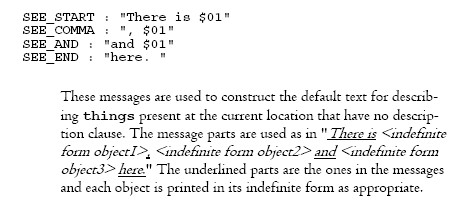 The message we want to change is "SEE_START".MESSAGE SEE_START : "You see $01"Adding this code will change the default response in the whole game. A convenient place for this code is just before the START section (see Compile and Play It!). Now the program will display to the player:You see some books here.Finish the books with a few appropriate VERBS....VERB examineDOES ONLY"The titles are:$p$t""Help""$n$t""Hint""$n$t""Credits""$n$t""Laugh"" "END VERB.VERB readDOES ONLY"Just type in the title of the book you want to read."END VERB.END THE books.-----------------------Another puzzle you could create (and it would be a nasty one, possibly making the game unwinnable) would be to make it necessary to push the box East (by the bookcase) and then for the player to stand on the box in order to reach and read the books. (That will be up to you, as well as creating the "hint" and "credits" books, er, VERBS.)Update the tv_room DESCRIPTION with the 'map'Since we will ask the player to push the box in one of the four cardinal directions, we should describe what those directions are in the LOCATION DESCRIPTION.-----------------------THE tv_room Isa LOCATIONNAME 'TV Room'DESCRIPTION"This is your favorite room in the house, because you love to watch television.Besides your comfy chair and table in the north end of the room, there is a bookcase on the east side and a bare wall on the west."IF tv HereTHEN"$pYour new plasma TV is here."ELSE"$pThere is a large cardboard packing carton here."END IF."$pThe door to the kitchen is south."EXIT south TO kitchenCHECK tv_door IS OPENELSE"$t$t<BUMP>$p$t$tOof!$pThe door is closed."DOES"You go south, into the kitchen."END EXIT.EXIT north TO tv_roomCHECK"Your chair and table are in the north end of the room."END EXIT.EXIT west TO tv_roomCHECK"There is only a wall in that direction."END EXIT.EXIT east TO tv_roomCHECK"The bookcase is on the east side of the room."END EXIT.END THE tv_room.-----------------------
 So Push It Already!
-
So Push It Already! Alan Manual v3.0 Preliminary Push the BoxOkay, time to program pushing the box. Let's begin by making the box moveable.-----------------------SYNONYMScrate = box.THE box Isa OBJECT AT tv_roomNAME packing carton NAME heavy cardboard boxNAME label NAME large black lettersNAME upward pointing arrowHAS weight 500.IS OPENABLE.MOVEABLE.HAS NOT SCENERY.DESCRIPTION...The MOVEABLE Attribute is the one we have assigned for both the "push" and the "pull" VERBS (here). We don't want the player to pull the box. Implement the VERB from "pull.i" to prevent it....VERB pullCHECK"You can't get a good grip on the carton to pull it.You might have better luck trying to push it."End Verb....Now we want to adapt the "push" VERB, to push the box in one of the four cardinal directions we have established in the game. So first we implement for the VERBS as they are in "push.i" to ask the player which direction they want to push it....Verb pushCHECK"Please say which direction you want to push it:$ppush the carton north, south, east or west."End Verb....Now let's add these "push" VERBS for each of the four cardinal directions to "push.i". They are adapted from VERBS that are already in the standard library (in "put.i").SYNTAXpush_north = push (obj) 'north'WHERE obj Isa thingElse "You can't push that."push_south = push (obj) 'south'WHERE obj Isa thingElse "You can't push that."push_east = push (obj) 'east'WHERE obj Isa thingElse "You can't push that."push_west = push (obj) 'west'WHERE obj Isa thingElse "You can't push that."ADD TO EVERY THINGVERB push_north, push_south, push_east, push_westCHECK obj IS MOVEABLEELSE"You can't push that."DOES"You push it in that direction."END VERB.END ADD TO.And finally let's implement the directional "push" VERBS for the box. We will create a "SPOT" Attribute for the box to indicate where it is in the room, depending on which direction the player pushes it. A value of Zero (0) will equal the center of the room, 1 will be equal to north; 2 to south, 3 to east and 4 to west.-----------------------SYNONYMScrate = box.THE box Isa OBJECT AT tv_roomNAME packing carton NAME heavy cardboard boxNAME label NAME large black lettersNAME upward pointing arrowHAS weight 500.IS OPENABLE.MOVEABLE.HAS NOT SCENERY.HAS SPOT 0. -- O = centered in the roomDESCRIPTION...VERB push_northDOES ONLYSET SPOT OF box TO 1. -- north"You push the box north, next to the chair and table."END VERB.The SET statement (¶ 4.16.6) is like the MAKE statement, to change Attributes. MAKE is used for Boolean Attributes; SET is used for non-Boolean Attributes. Here we SET the SPOT Attribute (where in the room the box is) to 1, north by the chair and table.VERB push_southDOES ONLYSET SPOT OF box TO 2."You push the box south, in front of the door."END VERB.VERB push_eastDOES ONLYSET SPOT OF box TO 3."You push the box east, next to the bookcase."END VERB.VERB push_westDOES ONLYSET SPOT OF box TO 4."You push the box west, next to the wall."END VERB....Update the tv_room DESCRIPTION for the Box-----------------------THE tv_room Isa LOCATIONNAME 'TV Room'DESCRIPTION"This is your favorite room in the house, because you love to watch television.Besides your comfy chair and table in the north end of the room, there is a bookcase on the east side and a bare wall on the west."IF tv HereTHEN"$pYour new plasma TV is here."ELSE"$pThere is a large cardboard packing carton sitting"IF spot OF box = 0 THEN "in the center of the room."ELSIF spot OF box = 1 THEN "next to the chair and table."ELSIF spot OF box = 2 THEN "against the door."ELSIF spot OF box = 3 THEN "by the bookcase."ELSIF spot OF box = 4 THEN "next to the wall."END IF.END IF."$pThe door to the kitchen is south."...This is a good place to introduce the DEPENDING ON statement. It is rather like a condensed IF-THEN statement; and like the IF-THEN, every DEPENDING ON requires an END DEPEND. Here is how it is used in the TV Room DESCRIPTION.-----------------------THE tv_room Isa LOCATIONNAME 'TV Room'DESCRIPTION"This is your favorite room in the house, because you love to watch television.Besides your comfy chair and table in the north end of the room, there is a bookcase on the east side and a bare wall on the west."IF tv HereTHEN"$pYour new plasma TV is here."ELSE"$pThere is a large cardboard packing carton sitting"DEPENDING ON spot OF box= 0 THEN "in the center of the room."= 1 THEN "next to the chair and table."= 2 THEN "against the door."= 3 THEN "by the bookcase."= 4 THEN "next to the wall."END DEPEND.END IF."$pThe door to the kitchen is south."... ...or Not!
-
...or Not! Alan Manual v3.0 Preliminary Opening the Box and Placing the TVWhen the player opens the box to remove the tv, the tv will of course be placed in the same "spot" where the box was. If the box is opened as it sits by the door, then the tv will be placed by the door. The first thing we need to do then is to give the SPOT Attribute to the tv, just like we did for the box..-----------------------SYNONYMStelevision = tv.THE tv Isa OBJECT AT Nowhere -- until box is openedNAME TV NAME plasma NAME brand NAME newNAME screen NAME giantNAME brand new giant screen plasma tvIS SWITCHABLE.HAS SPOT 0.DESCRIPTION...It will be easy to "spot" the tv where the box was, simply by setting the SPOT of the tv to that of the box when it is opened. We have several VERBS that open the box, but only one place in our code we have to change. We created an OBJECT at Nowhere to handle all the "open the box" VERBS (here).-----------------------THE open_box Isa OBJECT AT NowhereDESCRIPTIONLOCATE tv Here.LOCATE cord Here.LOCATE remote Here.LOCATE knife IN Hero.MAKE box SCENERY.SET SPOT OF tv TO SPOT OF box."Using the sharp blade of the knife, you cut the box open to reveal the plasma TV inside. You cut and tear off the remaining cardboard and cast it aside.$pWow, the TV looks even better in your home than it did on the showroomfloor!"END THE open_box.-----------------------Update the tv_room DESCRIPTION for the TV-----------------------THE tv_room Isa LOCATIONNAME 'TV Room'DESCRIPTION"This is your favorite room in the house, because you love to watch television.Besides your comfy chair and table in the north end of the room, there is a bookcase on the east side and a bare wall on the west."IF tv HereTHEN"$pYour new plasma TV is sitting"DEPENDING ON spot OF tv= 0 THEN "in the center of the room."= 1 THEN "next to the chair and table."= 2 THEN "against the door."= 3 THEN "by the bookcase."= 4 THEN "next to the wall."END DEPEND.ELSE"$pThere is a large cardboard packing carton sitting"DEPENDING ON spot OF box= 0 THEN "in the center of the room."= 1 THEN "next to the chair and table."= 2 THEN "against the door."= 3 THEN "by the bookcase."= 4 THEN "next to the wall."END DEPEND.END IF."$pThe door to the kitchen is south."...The Point of All That Pushing Things AroundThe point is that the power cord can only be plugged into the outlet if the tv is placed by the wall.Add a CHECK to the "plug" VERBS for both the outlet and tv_wall:...VERB plug_in, put_inWHEN obj2CHECK obj1 IS PLUGGABLEELSE"Hey, be careful! That doesn't go into an electrical outlet!"AND SPOT OF tv = 4ELSE"The cord is only three feet long.It can't reach the outlet from here."AND cord IS NOT PLUGGED_INELSE"The cord is already plugged in!"DOES ONLYMAKE cord PLUGGED_IN."You put the power cord snugly into the electrical outlet."END VERB....No Pushing the TV!What if the tv is not next to the wall? Unlike the box, it cannot be pushed. If the player does try more than one time to push it, the tv will tip over and break, losing the game.-----------------------SYNONYMStelevision = tv.THE tv Isa OBJECT AT Nowhere -- until box is openedNAME TV NAME plasma NAME brand NAME newNAME screen NAME giantNAME brand new giant screen plasma tvIS SWITCHABLE.MOVEABLE.HAS SPOT center.HAS TIPPY 1. -- To check for tipping over (see push VERB below).DESCRIPTION...VERB pull -- COPIED FROM THE boxCHECK"You can't get a good grip on the wide screen to pull it.You might have better luck trying to push it."End Verb....Verb pushDoes ONLYIF TIPPY OF tv >1 THEN"You push harder against the big plasma tv.$pOh no! It tips over and crashes to the floor.Your brand new plasma tv is broken.$p*** You have lost. *** "QUIT.ELSE"You will have to push the tv harder than thator find some other way to move it."INCREASE TIPPY OF tv.END IF.END VERB.The "INCREASE" statement will increase the numeric value by 1, unless you specify differently with "BY"; i.e., "INCREASE TIPPY OF tv BY 3."(It is up to you to add SYNTAX for "push_hard" and "push_harder" to the "push" VERB in "push.i"!) Another Way to Win
-
Another Way to Win Alan Manual v3.0 Preliminary Book 'em!It is generally not a good idea to let the game become unwinnable. Let's give the player an alternate way to push the tv, by placing the books from the bookcase under the tv.-----------------------THE books Isa OBJECT IN bookcaseNAME books NAME bookIS READABLE.INDEFINITE ARTICLE "some"VERB examineDOES ONLY"The titles are:$p$t""Help""$n$t""Hint""$n$t""Credits""$n$t""Laugh"" "END VERB.VERB readCHECK tv IS NOT BOOKEDELSE"That isn't possible while they are under the tv!"DOES ONLY"Just type in the title of the book you want to read."END VERB.VERB take, pick_up1, pick_up2CHECK tv IS NOT BOOKEDELSE"That isn't possible while they are under the tv!"DOES ONLYLOCATE books IN Hero"You take the books."END VERB.Verb put_underWhen obj1CHECK obj2 = tvELSE"It won't help anything to do that."Does ONLYLOCATE books Here.MAKE tv BOOKED.SET TIPPY of TV TO 0."You carefully lift each of the four corners of the plasma tvand slip a book under it."End Verb.END THE books.-----------------------Now might be a good time to create a custom response to the "hint" VERB to give the player a hint about how to move the tv. That is of course left for to you to do!Push the TVMake the tv pushable if the books are under it. We will give it an Attribute for the books under it (BOOKED), and code the "push" VERB to CHECK for it.-----------------------SYNONYMStelevision = tv.THE tv Isa OBJECT AT Nowhere -- until box is openedNAME TV NAME plasma NAME brand NAME newNAME screen NAME giantNAME brand new giant screen plasma tvIS SWITCHABLE.MOVEABLE.NOT BOOKED.HAS SPOT center.HAS TIPPY 1.DESCRIPTION...Now to implement pushing the tv north, south, east or west, first copy-and-paste the VERBS from the box, of course changing the word "box" to "tv".VERB push_northDOES ONLYSET SPOT OF tv TO 1."You push the tv north, next to the chair and table."END VERB.VERB push_southDOES ONLYSET SPOT OF tv TO 2."You push the tv south, in front of the door."END VERB.VERB push_eastDOES ONLYSET SPOT OF tv TO 3."You push the tv east, next to the bookcase."END VERB.VERB push_westDOES ONLYSET SPOT OF tv TO 4."You push the tv west, next to the wall."END VERB....ConsolidateAll these "push" VERBS will need to CHECK whether the tv IS BOOKED or not. If the tv IS NOT BOOKED then each "push" VERB will see if the TIPPY Attribute is greater than 1, and if so, QUIT the game with a "you lose" message.With five "push" VERBS, that means a lot of duplicated code. Again, however, it is a simple matter to avoid so much duplicated code for all these VERBS by creating an OBJECT at Nowhere to handle it.-----------------------THE tip_tv Isa OBJECT AT NowhereDESCRIPTIONIF TIPPY OF tv >1 THEN"You push harder against the big plasma tv.$pOh no! It tips over and crashes to the floor.Your brand new plasma tv is broken.$p*** You have lost. *** "QUIT.ELSE"You will have to push the tv harder than thator find some other way to move it."INCREASE TIPPY OF tv.END IF.END THE push_tv.-----------------------CHECK that the tv IS BOOKED, Add the tip_tv DESCRIPTION and the tv's "push" VERBS will be completed.Verb pushCHECK tv IS BOOKEDELSEDESCRIBE tip_tv.DOES ONLY"Please say which direction you want to push it:$ppush the carton north, south, east or west."END VERB.VERB push_northCHECK tv IS BOOKEDELSEDESCRIBE tip_tv.DOES ONLYSET SPOT OF tv TO 1."You push the box north, next to the chair and table."END VERB.VERB push_southCHECK tv IS BOOKEDELSEDESCRIBE tip_tv.DOES ONLYSET SPOT OF tv TO 2."You push the box south, in front of the door."END VERB.VERB push_eastCHECK tv IS BOOKEDELSEDESCRIBE tip_tv.DOES ONLYSET SPOT OF tv TO 3."You push the box east, next to the bookcase."END VERB.VERB push_westCHECK tv IS BOOKEDELSEDESCRIBE tip_tv.DOES ONLYSET SPOT OF tv TO 4."You push the box west, next to the wall."END VERB.Congratulations! This completes the main elements of our tutorial game. Compile and Play It!
-
Compile and Play It! Alan Manual v3.0 Preliminary ------------------------------------------------- *** TV TIME! ***-- An ALAN 3 Interactive Fiction Tutorial Game-- By Michael Arnaud © 2006-----------------------------------------------IMPORT 'std.i'.------------------------- *** CUSTOM CLASSES: ***Every SURFACE Isa OBJECTCONTAINERHEADER"Resting on top is"VERB examineDOES ONLYLIST THIS.END VERB.VERB put_inWHEN obj2CHECK"That isn't something you can put anything ""in""."END VERB.END EVERY.-----------------------Every CLOSEABLE Isa OBJECTOPAQUE CONTAINERHEADER"It contains"IS OPENABLE.VERB open DOES AFTERMAKE THIS NOT OPAQUE.LIST THIS.END VERB.VERB close DOES AFTERMAKE THIS OPAQUE.END VERB.END EVERY.-----------------------EVERY Door Isa OBJECTNAME doorHAS otherside Door.IS OPENABLE.DESCRIPTIONVERB openDOES AFTERMAKE otherside OF THIS open.END VERB.VERB closeDOES AFTERMAKE otherside OF THIS closed.END VERB.END EVERY.-----------------------THE tv_room Isa LOCATIONNAME 'TV Room'DESCRIPTION"This is your favorite room in the house, because you love to watchtelevision. Besides your comfy chair and table in the north end of theroom, there is a bookcase on the east side and a bare wall on the west."IF tv HereTHEN"$pYour new plasma TV is sitting"DEPENDING ON spot OF tv= 0 THEN "in the center of the room."= 1 THEN "next to the chair and table."= 2 THEN "against the door."= 3 THEN "by the bookcase."= 4 THEN "next to the wall."END DEPEND.ELSE"$pThere is a large cardboard packing carton sitting"DEPENDING ON spot OF box= 0 THEN "in the center of the room."= 1 THEN "next to the chair and table."= 2 THEN "against the door."= 3 THEN "by the bookcase."= 4 THEN "next to the wall."END DEPEND.END IF."$pThe door to the kitchen is south."EXIT south TO kitchenCHECK tv_door IS OPENELSE"$t$t<BUMP>$p$t$tOof!$pThe door is closed."DOES"You go south, into the kitchen."END EXIT.EXIT north TO tv_roomCHECK"Your chair and table are in the north end of the room."END EXIT.EXIT west TO tv_roomCHECK"There is only a wall in that direction."END EXIT.EXIT east TO tv_roomCHECK"The bookcase is on the east side of the room."END EXIT.END THE tv_room.-----------------------THE bkcase Isa SCENERY AT tv_roomNAME bookcase NAME caseNAME shelvesCONTAINERHEADER"In the bookcase you see"VERB examineDOES ONLY"It is a large bookcase. There are only a few books on its shelves:$p""Help""$n""Hint""$n""Credits""$n""Laugh"" "END VERB.END THE bkcase.-----------------------THE books Isa OBJECT IN bkcaseNAME books NAME bookIS READABLE.INDEFINITE ARTICLE "some"VERB examineDOES ONLY"The titles are:$p""Help""$n""Hint""$n""Credits""$n""Laugh"" "END VERB.VERB readCHECK tv IS NOT BOOKEDELSE"That isn't possible while they are under the tv!"DOES ONLY"Just type in the title of the book you want to read."END VERB.VERB take, pick_up1, pick_up2CHECK tv IS NOT BOOKEDELSE"That isn't possible while they are under the tv!"DOES ONLYLOCATE books IN Hero."You take the books."END VERB.Verb put_underWhen obj1CHECK obj2 = tvELSE"It won't help anything to do that."Does ONLYLOCATE books Here.MAKE tv BOOKED.SET TIPPY of TV TO 0."You carefully lift each of the four corners of the plasma tv and slip abook under it."End Verb.END THE books.-----------------------SYNONYMScrate = box.THE box Isa OBJECT AT tv_roomNAME packing carton NAME heavy cardboard boxNAME label NAME large black lettersNAME upward pointing arrowHAS weight 500.HAS spot 0.IS OPENABLE.NOT SCENERY.MOVEABLE.DESCRIPTIONVERB examineDOES ONLYIF box IS NOT SCENERYTHEN"It's quite large, about five feet square. Besides the label (""UltimoPlasma TV""), there are large black letters that say, ""PUSH WITHCARE"".$nAn upward pointing arrow indicates ""THIS SIDE UP"".""$pThe box is sitting by a wall."ELSE"The carton is in pieces. No need to worry about it now, you can cleanit up later."END IF.END VERB.Verb openCHECK box IS NOT SCENERYELSE"You have done that already."AND knife HereELSE"You will need a knife to cut the box open."Does ONLYDESCRIBE open_box.End Verb.Verb open_withWhen obj1CHECK box IS NOT SCENERYELSE"You have done that already."AND obj2 = knifeELSE"You will need something sharper than that to open the box with."Does ONLYDESCRIBE open_box.End Verb.VERB cutCHECK box IS NOT SCENERYELSE"You have done that already."AND knife HereELSE"You will need a knife to cut the box open."Does ONLYDESCRIBE open_box.End Verb.VERB cut_withWhen obj1CHECK box IS NOT SCENERYELSE"You have done that already."AND obj2 = knifeELSE"You will need something sharper than that to open the box with."Does ONLYDESCRIBE open_box.End Verb.VERB pullCHECK"You can't get a good grip on the carton to pull it. You might havebetter luck trying to push it."End Verb.Verb pushCHECK"Please say which direction you want to push it:$ppush the carton north, south, east or west."End Verb.Verb push_withWhen obj1Check"Just push the carton with your hands."End Verb.VERB push_northDOES ONLYSET spot OF box TO 1."You push the box north, next to the chair and table."END VERB.VERB push_southDOES ONLYSET spot OF box TO 2."You push the box south, in front of the door."END VERB.VERB push_eastDOES ONLYSET spot OF box TO 3."You push the box east, next to the bookcase."END VERB.VERB push_westDOES ONLYSET spot OF box TO 4."You push the box west, next to the wall."END VERB.END THE box.-----------------------THE open_box Isa OBJECT AT NowhereDESCRIPTIONLOCATE tv Here.LOCATE cord Here.LOCATE remote Here.LOCATE knife IN Hero.SET spot OF tv TO spot OF box."Using the sharp blade of the knife, you cut the box open to reveal theplasma TV inside. You cut and tear off the remaining cardboard and castit aside.$pWow, the TV looks even better in your home than it did on the showroomfloor!"END THE open_box.-----------------------THE remote Isa OBJECT AT NowhereNAME remote control NAME controllerNAME control remote NAME remoteNAME button NAME simple push buttonsOPAQUE CONTAINER -- so you can put the battery in itIS SWITCHABLE.PUSHABLE.VERB examineDOES ONLY"It's a very simple push-button remote control."END VERB.VERB put_inWHEN obj2CHECK obj1 = batteryELSE"Don't be silly. Only a battery goes in there!"DOES AFTER"You snap the battery into place in the remote."END VERB.VERB turn_on1, turn_on2, switch_on1, switch_on2CHECK battery IN remoteELSE"Pushing the button on the remote, nothing happens. The remote won't doanything without a battery."LOCATE remote IN Hero. -- Assumes remote is "Taken".AND cord IS PLUGGED_INELSE"The TV won't turn on. It isn't getting any power."DOES ONLYDESCRIBE win_tv.END VERB.VERB pushCHECK battery IN remoteELSE"Pushing the button on the remote, nothing happens. The remote won't doanything without a battery."LOCATE remote IN Hero.AND cord IS PLUGGED_INELSE"The TV won't turn on. It isn't getting any power."DOES ONLYDESCRIBE win_tv.END VERB.END THE remote.-----------------------SYNONYMStelevision = tv.THE tv Isa OBJECT AT Nowhere -- until box is openedNAME TV NAME plasma NAME brand NAME newNAME screen NAME giantNAME brand new giant screen plasma tvIS SWITCHABLE.PLUGGABLE.MOVEABLE.NOT BOOKED.HAS TIPPY 1.HAS spot 0.DESCRIPTIONVERB examineDOES ONLY"It's your 52-inch plasma pride and joy."END VERB.VERB take, pick_up1, pick_up2DOES ONLY"You try to wrap your arms around the giant screen but it is too wide.You can't get a good grip on the heavy TV to lift it."END VERB.VERB turn_on1, turn_on2, switch_on1, switch_on2CHECK remote HereELSE"There are no knobs, switches or buttons for turning on the TV."AND battery IN remoteELSE"Pushing the button on the remote, nothing happens.The remote won't do anything without a battery."LOCATE remote IN Hero. -- Assumes remote is "Taken".AND cord IS PLUGGED_INELSE"The TV won't turn on. It isn't getting any power."DOES ONLYDESCRIBE win_tv.END VERB.VERB pullCHECK"You can't get a good grip on the wide screen to pull it.You might have better luck trying to push it."End Verb.Verb pushCHECK tv IS BOOKEDELSEDESCRIBE tip_tv.DOES ONLY"Please say which direction you want to push it:$ppush the tv north, south, east or west."END VERB.VERB push_northCHECK tv IS BOOKEDELSEDESCRIBE tip_tv.DOES ONLYSET spot OF tv TO 1."You push the box north, next to the chair and table."END VERB.VERB push_southCHECK tv IS BOOKEDELSEDESCRIBE tip_tv.DOES ONLYSET spot OF tv TO 2."You push the box south, in front of the door."END VERB.VERB push_eastCHECK tv IS BOOKEDELSEDESCRIBE tip_tv.DOES ONLYSET spot OF tv TO 3."You push the box east, next to the bookcase."END VERB.VERB push_westCHECK tv IS BOOKEDELSEDESCRIBE tip_tv.DOES ONLYSET spot OF tv TO 4."You push the box west, next to the wall."END VERB.END THE tv.-----------------------THE tip_tv Isa OBJECT AT NowhereDESCRIPTIONIF TIPPY OF tv >1 THEN"You push harder against the big plasma tv.$pOh no! It tips over and crashes to the floor.Your brand new plasma tv is broken.$p*** You have lost. *** "QUIT.ELSE"You will have to push the tv harder than thator find some other way to move it."INCREASE TIPPY OF tv.END IF.END THE tip_tv.-----------------------THE win_tv Isa OBJECT AT NowhereDESCRIPTIONMAKE tv 'on'."Wow! What a great picture!"SHOW 'plasma.jpg'."$n$nYou watch the game and your favorite team wins!""$n$nAnd so have you...""$p*** You have won! *** "QUIT.END THE win_tv.-----------------------THE cord Isa OBJECT AT NowhereNAME cord NAME power electric electrical tv cordDESCRIPTIONIS PLUGGABLE.NOT PLUGGED_IN.VERB examineDOES ONLY"The power cord is of the common sort, and just three feet long."IF cord IS PLUGGED_INTHEN"It is plugged into the electric outlet."END IF.END VERB.VERB take, pick_up1, pick_up2CHECK"You can't take it. The power cord is permanently attached to thetelevision set."END VERB.END THE cord.----------------------THE battery Isa OBJECT AT NowhereVERB examineDOES ONLY"It's a regular household AAA battery."END VERB.END THE battery.-----------------------THE chair Isa OBJECT AT tv_roomNAME comfy chair NAME comfyNAME cushions NAME big soft chair cushionDESCRIPTIONVERB examineDOES ONLY"It's your favorite chair to sit in when you're watching the big game.It has big soft comfy cushions -- just the kind people lose change inall the time."END VERB.VERB searchCHECK battery AT NowhereELSE"There is nothing else to find by searching the chair."DOES ONLYLOCATE battery in Hero."You find a small battery, which you take."END VERB.END THE chair.-----------------------THE table Isa SURFACE AT tv_roomDESCRIPTIONVERB examine DOES BEFORE"It's an ordinary table, set conveniently by your chair."END VERB.VERB put_onWHEN obj2DOES ONLYLOCATE obj1 IN table."You set" Say The obj1. "on the table.""END VERB.END THE table.-----------------------THE tv_wall Isa SCENERY AT tv_roomCONTAINERHEADER ""NAME wall NAME wallsVERB examineDOES ONLY"The wall has an electric outlet."IF cord IS PLUGGED_INTHEN"The TV cord is plugged into it."END IF.END VERB.VERB plug_in, put_inWHEN obj2CHECK obj1 IS PLUGGABLEELSE"Hey, be careful! That doesn't go into an electrical outlet!"AND spot OF tv = 4ELSE"The cord is only three feet long. It can't reach the outlet from here."AND cord IS NOT PLUGGED_INELSE"The cord is already plugged in!"DOES ONLYMAKE cord PLUGGED_IN."You put the power cord snugly into the electrical outlet."END VERB.END THE tv_wall.-----------------------THE outlet Isa SCENERY AT tv_roomNAME outlet NAME electrical electric power wall wallplugCONTAINERHEADER ""VERB examineDOES ONLY"It's a three-prong electrical outlet."IF cord IS PLUGGED_INTHEN"The TV cord is plugged into it."END IF.END VERB.VERB plug_in, put_inWHEN obj2CHECK obj1 IS PLUGGABLEELSE"Hey, be careful! That doesn't go into an electrical outlet!"AND spot OF tv = 4ELSE"The cord is only three feet long.It can't reach the outlet from here."AND cord IS NOT PLUGGED_INELSE"The cord is already plugged in!"DOES ONLYMAKE cord PLUGGED_IN."You put the power cord snugly into the electrical outlet."END VERB.END THE outlet.-----------------------THE tv_door Isa Door AT tv_roomHAS otherside kitchen_door.END THE tv_door.-----------------------THE kitchen_door Isa Door AT kitchenHAS otherside tv_door.END THE kitchen_door.-----------------------THE kitchen Isa LOCATIONNAME 'Kitchen'DESCRIPTION"This is the kitchen. There is a counter and a cupboard here.$pNorth returns to the TV Room."EXIT north TO tv_roomCHECK kitchen_door IS OPENELSE"$t$t<BUMP>$p$t$tOof!$pThe door is closed."DOES"You return to the TV Room, north."END EXIT.EXIT south, east, west TO kitchenCHECK"There is only a wall in that direction."END EXIT.END THE kitchen.-----------------------THE counter Isa SURFACE AT kitchenDESCRIPTIONEND THE counter.-----------------------THE cupboard Isa CLOSEABLE AT kitchenNAME cupboard NAME cabinetDESCRIPTIONEND THE cupboard.-----------------------THE knife Isa OBJECT IN cupboardVERB examineDOES ONLY"It's a sturdy, sharp knife."END VERB.END THE knife.-----------------------MESSAGE SEE_START: "You see $01"-----------------------START AT tv_room."$p$t$t$t$t$t$t$t$t$t*** TV TIME! ***$n$t$t$t$t$t$tAn ALAN 3 Interactive Fiction Tutorial Game$n$t$t$t$t$t$t$tBy Michael Arnaud © 2006$p(Type ""help"" if you have not played this kind of game before.)$pJoy of joys, you have just purchased a brand new big screen plasma TVthat was delivered earlier today!"
PART TEN: Using EVENTS
-
PART TEN: Using EVENTS Setting a Bomb
-
Setting a Bomb Alan Manual v3.0 Preliminary Timed EVENTSEVENTS are used to perform an action according to time rather than space; or to put it simply, they act after a certain number of turns have passed. They can be set to happen immediately (after zero turns) or timed to happen after many turns; to happen at or to an OBJECT, or the player, or another ACTOR, or in a separate LOCATION.EVENTS are often used for color and atmosphere and for "time bomb" effects. We will program an example of each for our game. A "time bomb" effect requires the player to complete a particular goal (i.e. reach a LOCATION or perform an action) before a certain number of turns have passed. Failure to complete the goal may result in death or an otherwise lost game.A Simple EVENT ExampleAn EVENT requires three basic parts:1 - an OBJECT, ACTOR or LOCATION to act upon;2 - an EVENT statement performing the actions and descriptions; and3 - a SCHEDULE statement to tell the EVENT when to act, and optionally where.Here is a simple time bomb EVENT:-- 1 : THE OBJECTTHE bomb Isa OBJECT AT enemy_fortEND THE bomb.-- 2 : THE EVENTEVENT bomb_explode"$t$t<KA-BLOOEY!!>$pThe bomb exploded!$p*** You have lost. ***"QUIT.END EVENT.-- 3 : THE SCHEDULE STATEMENTSCHEDULE bomb_explode AT bomb AFTER 50.The SCHEDULE statement is rather like a fuse. If not "lit", it will not start counting turns, it will not trigger the EVENT, it will not do anything. It must be told to trigger the EVENT. So simply setting the SCHEDULE EVENT statement somewhere in the program will not make anything happen. It needs to be triggered by something else, like a VERB or in the START AT section.THE bomb Isa OBJECT AT enemy_fortVERB touchDOES ONLY"Oh no! Your touch has started the bomb's timer ticking!"SCHEDULE bomb_explode AT bomb AFTER 50.END VERB.END THE bomb.That's really all there is to it. After 50 turns the bomb will explode and give the "lose" message.We can add to the atmosphere and increase the tension with a repeating EVENT. This is done simply by embedding a (re-)SCHEDULE statement within the EVENT you want to repeat.EVENT bomb_tick"$t<tick... tick...>$pThe bomb is ticking. Time is getting short."SCHEDULE bomb_tick AFTER 3.END EVENT.Every three turns the "tick" message will display until the bomb explodes and the game ends.But suppose the player is able to defuse the bomb in time. We don't want the bomb to explode after being defused, so we CANCEL the EVENT.THE bomb Isa OBJECT AT enemy_fortVERB touchDOES ONLY"Oh no! Your touch has started the timer to explode!"SCHEDULE bomb_explode AT bomb AFTER 50.END VERB.VERB defuse"You remove the timer and fuse from the bomb. Whew!"CANCEL bomb_explode.CANCEL bomb_tick.END VERB.END THE bomb.EVENTS are very easy to program, and add a great deal of color to the game.A Sporting GoalThe "time bomb" in our game will not explode. Rather, the player will only have to successfully turn on the tv in time to watch his (her) favorite sports team play for the championship; failure loses the game. Here is how we will tell the player what the goal is:-----------------------START AT tv_room."$p$t$t$t$t$t$t$t$t$t*** TV TIME! ***$n$t$t$t$t$t$tAn ALAN 3 Interactive Fiction Tutorial Game$n$t$t$t$t$t$t$tBy Michael Arnaud © 2006$p(Type ""help"" if you have not played this kind of game before.)$pThe greatest delight in your life is watching tv sports. And the one thing that matters most to you right now is the championship game that your favorite team will play this afternoon.$pJoy of joys, you have just purchased a brand new big screen plasma TVthat was delivered earlier today!"and...-----------------------THE guide Isa OBJECT IN tableNAME tv 'schedule' NAME program guideIS READABLE.VERB examineDOES ONLY"It is a listing of tv programming for the week. It is opened to today's schedule."END VERB.VERB readDOES ONLYIF guide NOT IN HeroTHENLOCATE guide IN Hero."(First picking it up)$p"END IF."The championship game will be played at 4 o'clock this afternoon!"END VERB.END THE guide.-----------------------The next thing to do is to tell the player what time it is. That is for the next section. Finding a Clock
-
Finding a Clock Searching Outside ResourcesObviously if we want to tell the player what time it is, we need a clock. We could invent one to include in our game. But there are often another resources to turn to, especially for complex or difficult tasks such as programming an Interactive Fiction clock. Such resources are the ALAN Yahoo! Group and the ALAN website as well as the Google newsgroups r.a.i.f. and r.g.i.f. mentioned in the Introduction to this guide.Searching these resources, your humble author found a clock at the Alan website (click here). The author of the clock is Steve Griffiths. Thank you, Steve, we are all grateful.Given below is that same clock, only removed from the train platform and schedule, stripped down and rewired. I have made it into a rather generic clock to include in this game as well as in others we might wish to write. If you like it, I suggest keeping it in a separate folder of library add-ons.Don't be put off or overwhelmed by what may appear to be complex or advanced programming. It is that, but that is why we copied it from elsewhere. That is one of the two points I am trying to convey to you the reader: one: outside resources can help in a big way; and two: the clock is still just a simple OBJECT, EVENT, and SCHEDULE statement.-- clockThe clock Isa objectHas hour 4. -- set these three attributesHas minute 50. -- to specify the time of dayHas ampm "pm". -- you want when the game startsHas timeinminutes 0. -- (the time expressed as minutes past midnight. This is-- calculated by the game - in the START section - and-- updated each turn by the TickTock event so left-- at the default initial value here)Verb readDoes Only-- Display the time on screen"$pThe clock reads"Say hour Of clock."$$:$$"If minute Of clock >9 ThenSay minute Of clock.Else"0$$"Say minute Of clock.End If.Say ampm Of clock.End Verb.End The clock.Event ticktock-- Increments The Time By Another Minute-- Convert Time From "Minutes Past Midnight" To Hh:Mm Am/Pm FormatSet hour Of clock To timeinminutes Of clock /60.If hour Of clock >=12 ThenSet ampm Of clock To"pm".If hour Of clock >12 ThenSet hour Of clock To hour Of clock -12.End If.ElseSet ampm Of clock To"am".If hour Of clock =0 ThenSet hour Of clock To 12.End If.End If.Set minute Of clock To timeinminutes Of clock -((timeinminutes Of clock /60) *60).-- Increment time by one minute-- (If its 11:59pm set clock to zero ie:midnight instead)If timeinminutes Of clock <1439 ThenIncrease timeinminutes Of clock.ElseSet timeinminutes Of clock To 0.End If.-- schedule this event to happen again next turnSchedule ticktock After 1.End Event ticktock.-- Information for the START AT sectionStart At starting_location.-- Convert the clock's initial time-- from the hh:mm am/pm format-- used in source-code to "minutes past midnight" format to make-- calculations easierSet timeinminutes Of clock To (hour Of clock *60) +minute Of clock.If ampm Of clock ="pm" ThenIf hour Of clock <12 ThenSet timeinminutes Of clock To (timeinminutes Of clock +720).End If.End If.Schedule ticktock After 0. -- start the clock "ticking" Set the Clock
-
Set the Clock Alan Manual v3.0 Preliminary Set the Clock in the GameThe clock as stripped down in the previous section is no longer an ".alan" (game source) file; neither is it an ".i" file to be imported. What it is, is a resource to copy, paste, and set to our particular use. Here is how we will use it in our game.Create the Clock OBJECT in the Kitchen-----------------------The clock Isa object AT KitchenIS READABLE.DESCRIPTIONHas hour 3. -- set these three attributesHas minute 15. -- to specify the time of dayHas ampm "pm". -- you want when the game startsHas timeinminutes 0. -- (the time expressed as minutes past midnight. This is-- calculated by the game - in the START section - and-- updated each turn by the TickTock event so left-- at the default initial value here)Verb readDoes Only-- Display the time on screen"$pThe clock reads"Say hour Of clock."$$:$$"If minute Of clock >9 ThenSay minute Of clock.Else"0$$"Say minute Of clock.End If.Say ampm Of clock.End Verb.VERB examineDoes Only-- Display the time on screen"$pThe clock reads"Say hour Of clock."$$:$$"If minute Of clock >9 ThenSay minute Of clock.Else"0$$"Say minute Of clock.End If.Say ampm Of clock.End Verb.End The clock.-----------------------SCHEDULE the Clock to "Tick" in START AT-----------------------START AT tv_room.Set timeinminutes Of clock To (hour Of clock *60) +minute Of clock.If ampm Of clock ="pm" ThenIf hour Of clock <12 ThenSet timeinminutes Of clock To (timeinminutes Of clock +720).End If.End If.Schedule ticktock After 0. -- start the clock "ticking""$p$t$t$t$t$t$t$t$t$t*** TV TIME! ***$n$t$t$t$t$t$tAn ALAN 3 Interactive Fiction Tutorial Game$n$t$t$t$t$t$t$tBy Michael Arnaud © 2006$p(Type ""help"" if you have not played this kind of game before.)$pThe greatest delight in your life is watching tv sports. And the one thing that matters most to you right now is the championship game that your favorite team will play this afternoon.$pJoy of joys, you have just purchased a brand new big screen plasma TVthat was delivered earlier today!"The "ticktock" EVENTNothing new to add to this, just copy and paste.-----------------------Event ticktock-- Increments The Time By Another Minute-- Convert Time From "Minutes Past Midnight" To Hh:Mm Am/Pm FormatSet hour Of clock To timeinminutes Of clock /60.If hour Of clock >=12 ThenSet ampm Of clock To"pm".If hour Of clock >12 ThenSet hour Of clock To hour Of clock -12.End If.ElseSet ampm Of clock To"am".If hour Of clock =0 ThenSet hour Of clock To 12.End If.End If.Set minute Of clock To timeinminutes Of clock -((timeinminutes Of clock /60) *60).-- Increment time by one minute-- (If its 11:59pm set clock to zero ie:midnight instead)If timeinminutes Of clock <1439 ThenIncrease timeinminutes Of clock.ElseSet timeinminutes Of clock To 0.End If.-- schedule this event to happen again next turnSchedule ticktock After 1.End Event ticktock.Update the Kitchen DESCRIPTION for the Clock-----------------------THE kitchen Isa LOCATIONNAME 'Kitchen'DESCRIPTION"This is the kitchen. There is a counter and a cupboard here, as well as a clock.$pNorth returns to the TV Room."EXIT north TO tv_roomCHECK kitchen_door IS OPENELSE"$t$t<BUMP>$p$t$tOof!$pThe door is closed."DOES"You return to the TV Room, north."END EXIT.EXIT south, east, west TO kitchenCHECK"There is only a wall in that direction."END EXIT.END THE kitchen.-----------------------Check the TimeWhen the player successfully turns on the tv, the last thing to check before winning the game is whether he/she turned the tv on in time for the big game. Since we created an OBJECT at Nowhere to act as a sub-routine for us when the player turns on the TV, we will check the time there.-----------------------THE win_tv Isa OBJECT AT NowhereDESCRIPTIONIF timeinminutes OF clock > 960 -- 4 pm in minutesTHEN"Ohhh, it's too late!$nYou missed the big game...$p*** You have lost. *** "QUIT.ELSEMAKE tv 'on'."Wow! What a great picture!"SHOW 'plasma.jpg'."$n$nYou watch the game and your favorite team wins!""$n$nAnd so have you...""$p*** You have won! *** "QUIT.END IF.END THE win_tv.-----------------------The clock "time bomb" EVENT is completed. Try it! A Colorful EVENT
-
A Colorful EVENT Alan Manual v3.0 Preliminary A Colorful EVENTIt often helps to add color and direction to the game to have a repeating EVENT, much like the "time bomb" example here. We will trigger a repeating EVENT reminding the player of time going by, once they read the tv schedule.First, the EVENT:-----------------------EVENT time_pass"$pThe clock is ticking..."SCHEDULE time_pass AT Hero AFTER 4.END EVENT.-----------------------As we have seen, this will print the "clock is ticking" message to the screen every four turns. It would probably be better if this message were not to become obviously routine to the player, i.e., that it will appear every four turns. We can vary the interval to whatever we like, say, randomly every four to six turns. For this we use the RANDOM statement:-----------------------EVENT time_pass"$pThe clock is ticking..."SCHEDULE time_pass AT Hero AFTER RANDOM 4 TO 6.END EVENT.-----------------------We can vary the message as well, using the RANDOM statement along with DEPENDING ON.-----------------------EVENT time_passDEPENDING ON RANDOM 1 to 3= 1 THEN "$pThe time for the big game is getting nearer."= 2 THEN "$pDon't let time get away from you!"= 3 THEN "$pThe clock is ticking..."END DEPEND.SCHEDULE time_pass AT Hero AFTER RANDOM 4 to 6.END EVENT.-----------------------The program will generate a "random" number from 1 to 3, and DEPENDING ON what number it is, will print that message to the screen. Then it will generate another "random" number from 4 to 6, and SCHEDULE the EVENT to happen again at that interval.Trigger the SCHEDULE with a VERBWe will SCHEDULE the time_pass EVENT to begin after the player reads the tv guide. But we don't want the EVENT to happen immediately upon their reading it, but a few turns after that.-----------------------THE guide Isa OBJECT IN tableNAME tv 'schedule' NAME program guideIS READABLE.VERB examineDOES ONLY"It is a listing of tv programming for the week. It is opened to today's schedule."END VERB.VERB readDOES ONLYIF guide NOT IN HeroTHENLOCATE guide IN Hero."(First picking it up)$p"END IF.SCHEDULE time_pass AT Hero AFTER 4."The championship game will be played at 4 o'clock this afternoon!"END VERB.END THE guide.-----------------------That completes our game and the tutorial. I hope this proves to be a help to you in using the Alan 3 Adventure language. Compile and Play It!
-
Compile and Play It! Alan Manual v3.0 Preliminary ------------------------------------------------- *** TV TIME! ***-- An ALAN 3 Interactive Fiction Tutorial Game-- By Michael Arnaud © 2006-----------------------------------------------IMPORT 'std.i'.------------------------- *** CUSTOM CLASSES: ***Every SURFACE Isa OBJECTCONTAINERHEADER"Resting on top is"VERB examineDOES ONLYLIST THIS.END VERB.VERB put_inWHEN obj2CHECK"That isn't something you can put anything ""in""."END VERB.END EVERY.-----------------------Every CLOSEABLE Isa OBJECTOPAQUE CONTAINERHEADER"It contains"IS OPENABLE.VERB open DOES AFTERMAKE THIS NOT OPAQUE.LIST THIS.END VERB.VERB close DOES AFTERMAKE THIS OPAQUE.END VERB.END EVERY.-----------------------EVERY Door Isa OBJECTNAME doorHAS otherside Door.IS OPENABLE.DESCRIPTIONVERB openDOES AFTERMAKE otherside OF THIS open.END VERB.VERB closeDOES AFTERMAKE otherside OF THIS closed.END VERB.END EVERY.-----------------------THE tv_room Isa LOCATIONNAME 'TV Room'DESCRIPTION"This is your favorite room in the house, because you love to watchtelevision. Besides your comfy chair and table in the north end of theroom, there is a bookcase on the east side and a bare wall on the west."IF tv HereTHEN"$pYour new plasma TV is sitting"DEPENDING ON spot OF tv= 0 THEN "in the center of the room."= 1 THEN "next to the chair and table."= 2 THEN "against the door."= 3 THEN "by the bookcase."= 4 THEN "next to the wall."END DEPEND.ELSE"$pThere is a large cardboard packing carton sitting"DEPENDING ON spot OF box= 0 THEN "in the center of the room."= 1 THEN "next to the chair and table."= 2 THEN "against the door."= 3 THEN "by the bookcase."= 4 THEN "next to the wall."END DEPEND.END IF."$pThe door to the kitchen is south."EXIT south TO kitchenCHECK tv_door IS OPENELSE"$t$t<BUMP>$p$t$tOof!$pThe door is closed."DOES"You go south, into the kitchen."END EXIT.EXIT north TO tv_roomCHECK"Your chair and table are in the north end of the room."END EXIT.EXIT west TO tv_roomCHECK"There is only a wall in that direction."END EXIT.EXIT east TO tv_roomCHECK"The bookcase is on the east side of the room."END EXIT.END THE tv_room.-----------------------THE bkcase Isa SCENERY AT tv_roomNAME bookcase NAME caseNAME shelvesCONTAINERHEADER"In the bookcase you see"VERB examineDOES ONLY"It is a large bookcase. There are only a few books on its shelves:$p""Help""$n""Hint""$n""Credits""$n""Laugh"" "END VERB.END THE bkcase.-----------------------THE books Isa OBJECT IN bkcaseNAME books NAME bookIS READABLE.INDEFINITE ARTICLE "some"VERB examineDOES ONLY"The titles are:$p""Help""$n""Hint""$n""Credits""$n""Laugh"" "END VERB.VERB readCHECK tv IS NOT BOOKEDELSE"That isn't possible while they are under the tv!"DOES ONLY"Just type in the title of the book you want to read."END VERB.VERB take, pick_up1, pick_up2CHECK tv IS NOT BOOKEDELSE"That isn't possible while they are under the tv!"DOES ONLYLOCATE books IN Hero."You take the books."END VERB.Verb put_underWhen obj1CHECK obj2 = tvELSE"It won't help anything to do that."Does ONLYLOCATE books Here.MAKE tv BOOKED.SET TIPPY of TV TO 0."You carefully lift each of the four corners of the plasma tv and slip abook under it."End Verb.END THE books.-----------------------SYNONYMScrate = box.THE box Isa OBJECT AT tv_roomNAME packing carton NAME heavy cardboard boxNAME label NAME large black lettersNAME upward pointing arrowHAS weight 500.HAS spot 0.IS OPENABLE.NOT SCENERY.MOVEABLE.DESCRIPTIONVERB examineDOES ONLYIF box IS NOT SCENERYTHEN"It's quite large, about five feet square. Besides the label (""UltimoPlasma TV""), there are large black letters that say, ""PUSH WITHCARE"".$nAn upward pointing arrow indicates ""THIS SIDE UP"".""$pThe box is sitting by a wall."ELSE"The carton is in pieces. No need to worry about it now, you can cleanit up later."END IF.END VERB.Verb openCHECK box IS NOT SCENERYELSE"You have done that already."AND knife HereELSE"You will need a knife to cut the box open."Does ONLYDESCRIBE open_box.End Verb.Verb open_withWhen obj1CHECK box IS NOT SCENERYELSE"You have done that already."AND obj2 = knifeELSE"You will need something sharper than that to open the box with."Does ONLYDESCRIBE open_box.End Verb.VERB cutCHECK box IS NOT SCENERYELSE"You have done that already."AND knife HereELSE"You will need a knife to cut the box open."Does ONLYDESCRIBE open_box.End Verb.VERB cut_withWhen obj1CHECK box IS NOT SCENERYELSE"You have done that already."AND obj2 = knifeELSE"You will need something sharper than that to open the box with."Does ONLYDESCRIBE open_box.End Verb.VERB pullCHECK"You can't get a good grip on the carton to pull it. You might havebetter luck trying to push it."End Verb.Verb pushCHECK"Please say which direction you want to push it:$ppush the carton north, south, east or west."End Verb.Verb push_withWhen obj1Check"Just push the carton with your hands."End Verb.VERB push_northDOES ONLYSET spot OF box TO 1."You push the box north, next to the chair and table."END VERB.VERB push_southDOES ONLYSET spot OF box TO 2."You push the box south, in front of the door."END VERB.VERB push_eastDOES ONLYSET spot OF box TO 3."You push the box east, next to the bookcase."END VERB.VERB push_westDOES ONLYSET spot OF box TO 4."You push the box west, next to the wall."END VERB.END THE box.-----------------------THE open_box Isa OBJECT AT NowhereDESCRIPTIONLOCATE tv Here.LOCATE cord Here.LOCATE remote Here.LOCATE knife IN Hero.SET spot OF tv TO spot OF box."Using the sharp blade of the knife, you cut the box open to reveal theplasma TV inside. You cut and tear off the remaining cardboard and castit aside.$pWow, the TV looks even better in your home than it did on the showroomfloor!"END THE open_box.-----------------------THE remote Isa OBJECT AT NowhereNAME remote control NAME controllerNAME control remote NAME remoteNAME button NAME simple push buttonsOPAQUE CONTAINER -- so you can put the battery in itIS SWITCHABLE.PUSHABLE.VERB examineDOES ONLY"It's a very simple push-button remote control."END VERB.VERB put_inWHEN obj2CHECK obj1 = batteryELSE"Don't be silly. Only a battery goes in there!"DOES AFTER"You snap the battery into place in the remote."END VERB.VERB turn_on1, turn_on2, switch_on1, switch_on2CHECK battery IN remoteELSE"Pushing the button on the remote, nothing happens. The remote won't doanything without a battery."LOCATE remote IN Hero. -- Assumes remote is "Taken".AND cord IS PLUGGED_INELSE"The TV won't turn on. It isn't getting any power."DOES ONLYDESCRIBE win_tv.END VERB.VERB pushCHECK battery IN remoteELSE"Pushing the button on the remote, nothing happens. The remote won't doanything without a battery."LOCATE remote IN Hero.AND cord IS PLUGGED_INELSE"The TV won't turn on. It isn't getting any power."DOES ONLYDESCRIBE win_tv.END VERB.END THE remote.-----------------------SYNONYMStelevision = tv.THE tv Isa OBJECT AT Nowhere -- until box is openedNAME TV NAME plasma NAME brand NAME newNAME screen NAME giantNAME brand new giant screen plasma tvIS SWITCHABLE.PLUGGABLE.MOVEABLE.NOT BOOKED.HAS TIPPY 1.HAS spot 0.DESCRIPTIONVERB examineDOES ONLY"It's your 52-inch plasma pride and joy."END VERB.VERB take, pick_up1, pick_up2DOES ONLY"You try to wrap your arms around the giant screen but it is too wide.You can't get a good grip on the heavy TV to lift it."END VERB.VERB turn_on1, turn_on2, switch_on1, switch_on2CHECK remote HereELSE"There are no knobs, switches or buttons for turning on the TV."AND battery IN remoteELSE"Pushing the button on the remote, nothing happens.The remote won't do anything without a battery."LOCATE remote IN Hero. -- Assumes remote is "Taken".AND cord IS PLUGGED_INELSE"The TV won't turn on. It isn't getting any power."DOES ONLYDESCRIBE win_tv.END VERB.VERB pullCHECK"You can't get a good grip on the wide screen to pull it.You might have better luck trying to push it."End Verb.Verb pushCHECK tv IS BOOKEDELSEDESCRIBE tip_tv.DOES ONLY"Please say which direction you want to push it:$ppush the tv north, south, east or west."END VERB.VERB push_northCHECK tv IS BOOKEDELSEDESCRIBE tip_tv.DOES ONLYSET spot OF tv TO 1."You push the box north, next to the chair and table."END VERB.VERB push_southCHECK tv IS BOOKEDELSEDESCRIBE tip_tv.DOES ONLYSET spot OF tv TO 2."You push the box south, in front of the door."END VERB.VERB push_eastCHECK tv IS BOOKEDELSEDESCRIBE tip_tv.DOES ONLYSET spot OF tv TO 3."You push the box east, next to the bookcase."END VERB.VERB push_westCHECK tv IS BOOKEDELSEDESCRIBE tip_tv.DOES ONLYSET spot OF tv TO 4."You push the box west, next to the wall."END VERB.END THE tv.-----------------------THE tip_tv Isa OBJECT AT NowhereDESCRIPTIONIF TIPPY OF tv >1 THEN"You push harder against the big plasma tv.$pOh no! It tips over and crashes to the floor.Your brand new plasma tv is broken.$p*** You have lost. *** "QUIT.ELSE"You will have to push the tv harder than thator find some other way to move it."INCREASE TIPPY OF tv.END IF.END THE tip_tv.-----------------------THE win_tv Isa OBJECT AT NowhereDESCRIPTIONIF timeinminutes OF clock > 960THEN"Ohhh, it's too late!$nYou missed the big game...$p*** You have lost. *** "QUIT.ELSEMAKE tv 'on'."Wow! What a great picture!"SHOW 'plasma.jpg'."$n$nYou watch the game and your favorite team wins!""$n$nAnd so have you...""$p*** You have won! *** "QUIT.END IF.END THE win_tv.-----------------------THE cord Isa OBJECT AT NowhereNAME cord NAME power electric electrical tv cordDESCRIPTIONIS PLUGGABLE.NOT PLUGGED_IN.VERB examineDOES ONLY"The power cord is of the common sort, and just three feet long."IF cord IS PLUGGED_INTHEN"It is plugged into the electric outlet."END IF.END VERB.VERB take, pick_up1, pick_up2CHECK"You can't take it. The power cord is permanently attached to thetelevision set."END VERB.END THE cord.----------------------THE battery Isa OBJECT AT NowhereVERB examineDOES ONLY"It's a regular household AAA battery."END VERB.END THE battery.-----------------------THE chair Isa OBJECT AT tv_roomNAME comfy chair NAME comfyNAME cushions NAME big soft chair cushionDESCRIPTIONVERB examineDOES ONLY"It's your favorite chair to sit in when you're watching the big game.It has big soft comfy cushions -- just the kind people lose change inall the time."END VERB.VERB searchCHECK battery AT NowhereELSE"There is nothing else to find by searching the chair."DOES ONLYLOCATE battery in Hero."You find a small battery, which you take."END VERB.END THE chair.-----------------------THE table Isa SURFACE AT tv_roomDESCRIPTIONVERB examine DOES BEFORE"It's an ordinary table, set conveniently by your chair."END VERB.VERB put_onWHEN obj2DOES ONLYLOCATE obj1 IN table."You set" Say The obj1. "on the table.""END VERB.END THE table.-----------------------THE guide Isa OBJECT IN tableNAME tv 'schedule' NAME program guideIS READABLE.VERB examineDOES ONLY"It is a listing of tv programming for the week. It is opened to today's schedule."END VERB.VERB readDOES ONLYIF guide NOT IN HeroTHENLOCATE guide IN Hero."(First picking it up)$p"END IF.SCHEDULE time_pass AT Hero AFTER 4."The championship game will be played at 4 o'clock this afternoon!"END VERB.END THE guide.-----------------------THE tv_wall Isa SCENERY AT tv_roomCONTAINERHEADER ""NAME wall NAME wallsVERB examineDOES ONLY"The wall has an electric outlet."IF cord IS PLUGGED_INTHEN"The TV cord is plugged into it."END IF.END VERB.VERB plug_in, put_inWHEN obj2CHECK obj1 IS PLUGGABLEELSE"Hey, be careful! That doesn't go into an electrical outlet!"AND spot OF tv = 4ELSE"The cord is only three feet long. It can't reach the outlet from here."AND cord IS NOT PLUGGED_INELSE"The cord is already plugged in!"DOES ONLYMAKE cord PLUGGED_IN."You put the power cord snugly into the electrical outlet."END VERB.END THE tv_wall.-----------------------THE outlet Isa SCENERY AT tv_roomNAME outlet NAME electrical electric power wall wallplugCONTAINERHEADER ""VERB examineDOES ONLY"It's a three-prong electrical outlet."IF cord IS PLUGGED_INTHEN"The TV cord is plugged into it."END IF.END VERB.VERB plug_in, put_inWHEN obj2CHECK obj1 IS PLUGGABLEELSE"Hey, be careful! That doesn't go into an electrical outlet!"AND spot OF tv = 4ELSE"The cord is only three feet long.It can't reach the outlet from here."AND cord IS NOT PLUGGED_INELSE"The cord is already plugged in!"DOES ONLYMAKE cord PLUGGED_IN."You put the power cord snugly into the electrical outlet."END VERB.END THE outlet.-----------------------THE tv_door Isa Door AT tv_roomHAS otherside kitchen_door.END THE tv_door.-----------------------THE kitchen_door Isa Door AT kitchenHAS otherside tv_door.END THE kitchen_door.-----------------------THE kitchen Isa LOCATIONNAME 'Kitchen'DESCRIPTION"This is the kitchen. There is a counter and a cupboard here.$pNorth returns to the TV Room."EXIT north TO tv_roomCHECK kitchen_door IS OPENELSE"$t$t<BUMP>$p$t$tOof!$pThe door is closed."DOES"You return to the TV Room, north."END EXIT.EXIT south, east, west TO kitchenCHECK"There is only a wall in that direction."END EXIT.END THE kitchen.-----------------------The clock Isa object AT KitchenIS READABLE.DESCRIPTIONHas hour 3. -- set these three attributesHas minute 15. -- to specify the time of dayHas ampm "pm". -- you want when the game startsHas timeinminutes 0. -- (the time expressed as minutes past midnight. This is-- calculated by the game - in the START section - and-- updated each turn by the TickTock event so left-- at the default initial value here)Verb readDoes Only-- Display the time on screen"$pThe clock reads"Say hour Of clock."$$:$$"If minute Of clock >9 ThenSay minute Of clock.Else"0$$"Say minute Of clock.End If.Say ampm Of clock.End Verb.VERB examineDoes Only-- Display the time on screen"$pThe clock reads"Say hour Of clock."$$:$$"If minute Of clock >9 ThenSay minute Of clock.Else"0$$"Say minute Of clock.End If.Say ampm Of clock.End Verb.End The clock.-----------------------THE counter Isa SURFACE AT kitchenDESCRIPTIONEND THE counter.-----------------------THE cupboard Isa CLOSEABLE AT kitchenNAME cupboard NAME cabinetDESCRIPTIONEND THE cupboard.-----------------------THE knife Isa OBJECT IN cupboardVERB examineDOES ONLY"It's a sturdy, sharp knife."END VERB.END THE knife.-----------------------Event ticktock-- Increments The Time By Another Minute-- Convert Time From "Minutes Past Midnight" To Hh:Mm Am/Pm FormatSet hour Of clock To timeinminutes Of clock /60.If hour Of clock >=12 ThenSet ampm Of clock To"pm".If hour Of clock >12 ThenSet hour Of clock To hour Of clock -12.End If.ElseSet ampm Of clock To"am".If hour Of clock =0 ThenSet hour Of clock To 12.End If.End If.Set minute Of clock To timeinminutes Of clock -((timeinminutes Of clock /60) *60).-- Increment time by one minute-- (If its 11:59pm set clock to zero ie:midnight instead)If timeinminutes Of clock <1439 ThenIncrease timeinminutes Of clock.ElseSet timeinminutes Of clock To 0.End If.-- schedule this event to happen again next turnSchedule ticktock After 1.End Event ticktock.-----------------------MESSAGE SEE_START: "You see $01"-----------------------START AT tv_room.Set timeinminutes Of clock To (hour Of clock *60) +minute Of clock.If ampm Of clock ="pm" ThenIf hour Of clock <12 ThenSet timeinminutes Of clock To (timeinminutes Of clock +720).End If.End If.Schedule ticktock After 0. -- start the clock "ticking""$p$t$t$t$t$t$t$t$t$t*** TV TIME! ***$n$t$t$t$t$t$tAn ALAN 3 Interactive Fiction Tutorial Game$n$t$t$t$t$t$t$tBy Michael Arnaud © 2006$p(Type ""help"" if you have not played this kind of game before.)$pThe greatest delight in your life is watching tv sports. And the one thing that matters most to you right now is the championship game that your favorite team will play this afternoon.$pJoy of joys, you have just purchased a brand new big screen plasma TVthat was delivered earlier today!"
Index
-
Index